From Default Management to Mutual Accountability: The New Reporting Relationship and What It Asks of You

For decades, accountability in First Nations funding ran one way: upward, to Ottawa. Communities reported to the federal government on how every dollar was spent, and a default-management regime stood ready to intervene whenever reports were late or finances strained. That model is now being taken apart. In its place, a relationship is emerging that treats First Nations as governments, not grant recipients - one built on mutual accountability, long-term funding, and far less routine reporting. The change is welcome. It also quietly shifts responsibility onto the community to own its own record.
Under the old system, federal reporting was the defining administrative load on a band office. Some communities filed dozens of separate reports a year, each to a different program with its own template and deadline, and the consequence of falling behind could be third-party management - an outside manager appointed to run the community's finances. The new fiscal relationship loosens that grip. But less external reporting does not mean less need for a strong internal record. When the federal backstop recedes, the discipline it once enforced has to come from within. A community that cannot quickly show where its money went, and why, is exposed in a different way.
Recent context
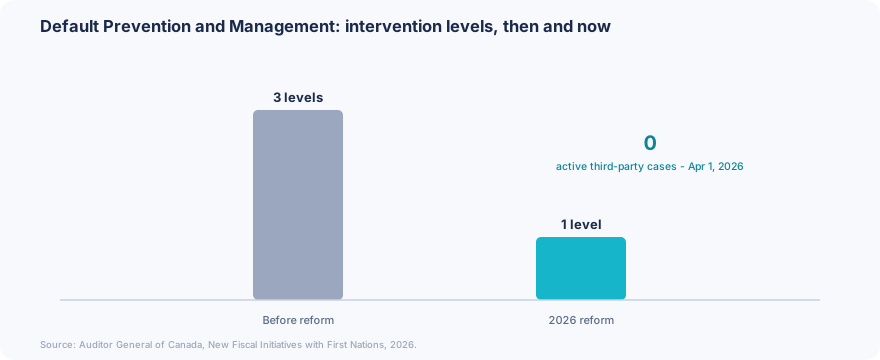
The direction is now official. The Auditor General of Canada's 2026 report on New Fiscal Initiatives with First Nations found that Indigenous Services Canada had removed the first two of three intervention levels of its punitive Default Prevention and Management Policy as inconsistent with self-determination - and that no community remained under third-party management as of April 1, 2026 - but had not yet replaced the policy or built the mutual accountability framework it promised. More than 200 First Nations governments now receive over $2 billion a year through the 10-year grant, with reduced reporting and the freedom to plan.
Why the record now sits with you
Mutual accountability is a better deal than default management. But 'mutual' has a catch: it works only when both sides can see clearly. A framework that holds the federal government to its commitments, and the community to its own, depends on a credible, current record on the community's side of the table. While that framework is still being co-developed, the practical safeguard is the community's own books, decisions, and project history - organized well enough that leadership can answer a hard question in minutes, not weeks. Self-determination in finance is not the absence of accountability; it is owning it.
How XNM helps
XNM helps communities turn a looser reporting regime into stronger internal control, not weaker. We work with finance and administration to build the routines, governance, and records that make accountability a community asset rather than a federal demand. Where it helps, the XNM-Vision platform keeps finances, documents, and the decision trail in one auditable place, so that whether the question comes from a funder, an auditor, a partner, or the community's own members, the answer already exists. The goal is a community that reports less to Ottawa and knows more about itself.
Practical takeaways
Keep your own books audit-ready. Less federal reporting is not less accounting; maintain clean, current financials as if scrutiny could come tomorrow.
Hold the decision trail. Record who decided what and why, so authority and intent stay clear long after the meeting.
Report to your members first. The most durable accountability is to citizens; a clear annual picture for the community builds trust and pre-empts outside doubt.
Don't let the backstop's exit create a gap. As default management recedes, replace the discipline it imposed with internal routines you control.
Be ready for the framework. A mutual accountability framework is coming; the communities ready to plug into it are the ones already keeping a strong record.
FAQ
Does less federal reporting mean we can relax our finances?
No - the opposite. The 10-year grant reduces routine reporting to Ottawa, but it raises the importance of your own internal record. With the default-management backstop gone, your books are your protection.
What is a mutual accountability framework?
It is a two-way agreement on what the federal government and a First Nation each owe the relationship - replacing one-directional, upward-only reporting. The Auditor General found it has not been built yet, so for now the community's own record carries more weight.
The bottom line
The era of default management is ending, and that is a win for self-determination. But the responsibility it carried does not disappear - it moves home. The communities that thrive under the new fiscal relationship will be the ones that treat their own record as the foundation of their authority: reporting less to Ottawa, and knowing more about themselves than anyone else at the table.