Capacity You Can Keep: Turning Funding and People Into Institutional Memory

A new wave of capacity funding is reaching First Nations governments - money to hire, to plan, and to strengthen the institutions that run a community. It is overdue and welcome. But capacity has a quiet failure mode: when it lives only in people, it leaves when they do. A finance director who carries a decade of project history in her head, a band administrator who knows where every agreement is filed - when they retire or move on, the knowledge can walk out the door with them. The question is not only how to build capacity, but how to keep it.
Capital projects make this acute. A single community capital project can run for years and outlast the people who started it - through funding applications, design changes, contractor disputes, and reporting cycles. The history of why a decision was made, what a funder required, or how a budget was reallocated often lives in one person's memory or one person's inbox. When that person leaves, a successor starts from fragments. The project does not just lose efficiency; it loses the thread of its own decisions, and the community pays the gap in delays, repeated mistakes, and weakened negotiating positions.
Recent context
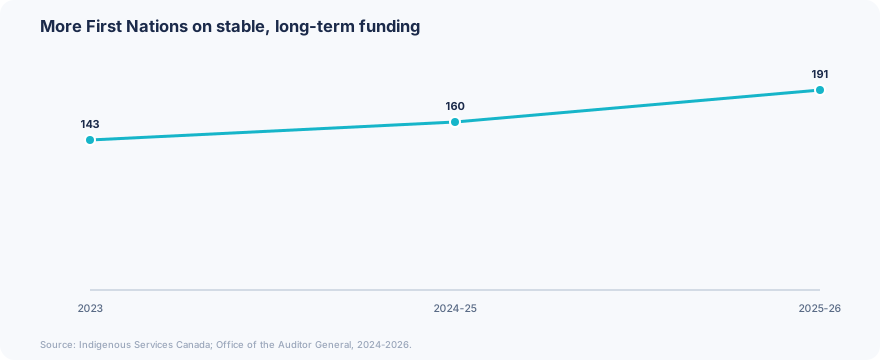
The investment side is moving. In March 2026, Indigenous Services Canada announced $738.9 million over five years to strengthen First Nations health, governance, and emergency management - through programs like Band Support Funding, Professional and Institutional Development, and Tribal Council Funding, aimed at building governance structures and the capacity to plan for the future. Alongside it, the 10-year New Fiscal Relationship grant - which gives communities stable, multi-year funding and reduced reporting - has grown to more than 200 participating First Nations and organizations.
Why capacity resets - and how to stop it
Funding can hire a skilled team, and stable, long-term grants can give them room to plan. But neither, on its own, keeps what the team learns. Institutional memory is the difference between a community that compounds its capacity year over year and one that resets it with every departure. The fix is not to depend on heroic individuals; it is to give the institution a memory of its own - a place where decisions, documents, finances, and project history live independently of who holds the job this year. When the knowledge is institutional, a staff change is a transition, not a reset.
How XNM helps
XNM helps communities convert capacity funding into capacity that lasts. We help establish the governance routines and records that hold knowledge at the level of the institution, not the individual. Where it helps, XNM-Vision keeps every project's documents, finances, decisions, and history in one place, so that when a key person leaves, their successor inherits a complete record instead of a cold trail. The investments Ottawa is making in people go further when the institution remembers what those people learned.
Practical takeaways
Make memory institutional, not personal. Knowledge that lives in one person's head or inbox is a risk; move it into systems the institution owns.
Document decisions as you go. Capture the why behind each major choice while it is fresh, so a successor can pick up the thread.
Plan for succession before you need to. Assume key people will eventually leave, and build handover into how you work, not into a panicked final week.
Use stable funding to build durable systems. Multi-year grants are the chance to invest in records and routines that outlast any single staff member.
Treat institutional memory as capacity. The knowledge a community retains is as real an asset as the people it employs - protect it accordingly.
FAQ
We just got capacity funding to hire. Isn't that enough?
Hiring is essential, but people move on. Unless the knowledge they build is captured in the institution, the next vacancy resets your progress. Pair the hire with a system that keeps what they learn.
We're a small community with high turnover. Is this realistic?
It is most important precisely where turnover is high. The smaller the team, the more damage a single departure does - and the more a shared, institutional record protects the community from starting over.
The bottom line
The money to build capacity is arriving, and the long-term funding to sustain it is spreading. The communities that turn that into lasting strength will be the ones that refuse to let knowledge leave with the people who hold it. Build capacity in your institutions, not just your staff - and the next departure becomes a handover, not a setback.