Anatomy of an Overrun: When Capital projects Outrun the Paperwork

Through 2024, forestry operators watched tighter scrutiny of provincial capital plans move money and attention toward big builds. The capital is the easy part. The hard part shows up later, in whether you can prove what you decided and when.
The stakes are simple. When you can't show a decision, you don't just lose an argument — you lose time, money, and the benefit of the doubt, usually all at once.
The records that settle questions
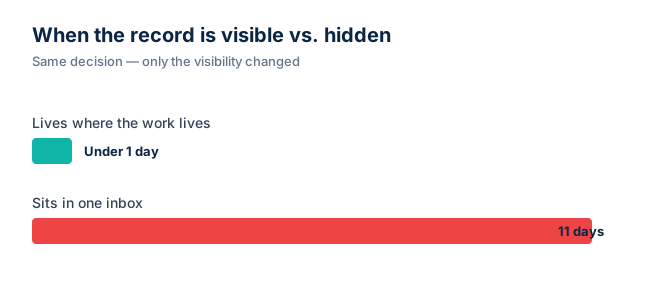
The real problem for forestry operators isn't missing information — it's unfindable information. The approval, the version, the justification all exist; they just don't live where the work can see them.
Look closer at any forestry operators and the same fault line appears: the people doing the work and the people who must answer for it are reading from different copies. One has the latest drawing; the other has last month's.
Consider how this plays out for forestry operators in practice. A decision gets made in a meeting, refined over a few emails, approved with a nod, and then executed by a crew who never saw any of it written down. Months later — often once tighter scrutiny of provincial capital plans has put every project under a brighter light — someone asks a question that should be easy: show me where this was approved, and by whom. The work itself was sound. The trail behind it was not. And it is precisely in that gap, between a good decision and a provable one, that budgets quietly disappear and schedules slip.
These are the records that go missing first:
The decision record — who approved what, when, and on what basis
Invoices matched to the contract that authorized them
The procurement justification, documented at the time
Version history proving which drawing was current on a given day
What tighter scrutiny of provincial capital plans actually changes
These are the records that turn a hard question into a two-minute answer:
Meeting minutes and direction. Especially anything that changed scope, schedule, or budget.
The contract and its change orders. The original plus every amendment, in order, with nothing living only in an email thread.
Invoices matched to the contract. Each dollar paid, tied to the commitment that authorized it.
Version history. Proof of which drawing, spec, or policy was current on any given day.
Procurement justification. Why this vendor, this price, this process — documented at the time, not rationalized after.
What changes the outcome isn't heroics at audit time. It's removing the gap between doing the work and recording it.
The XNM-VISION records engine turns the scattered exhaust of a project into a single auditable record. For forestry operators, that means a partner, funder, or auditor can be answered in minutes, not weeks.
Teams stand it up fast: the XNM-VISION records engine deploys in days, not the months a traditional system takes, and it carries unlimited users, so every partner, reviewer, and field lead works from the same picture.
Being delivery-ready early — with the record built in from day one — is the quiet advantage. It doesn't make headlines, but it's the difference between a project that finishes and one that stalls.
Where the work actually gets stuck
The pattern is consistent across capital programs. The first cost is not the budget — it is the time spent reconstructing what already happened. A status meeting becomes an archaeology session. A funder question turns into a two-week scavenger hunt. The people doing the real work end up doing the proving twice.
Consider a typical scenario: a community planner needs to confirm that a change order was authorized before an invoice clears. The contract is in a shared drive, the approval is in someone's inbox, the invoice is in the accounting system, and the photo of the as-built condition is on a phone. Each piece exists. None of them point at each other. That gap — not the missing document, but the missing link — is what audits, disputes, and refinancing conversations expose.
Most teams react by adding more discipline: another tracker, another weekly sync, another folder convention. It works for a quarter and then drifts, because the discipline lives in people's heads rather than in the record itself. The fix is structural: make the record the workspace, so doing the work and proving the work are the same motion.
The teams that consistently come through audits clean are not the teams with the most controls. They are the teams whose record is naturally complete because the tools they used to do the work also wrote the trail. That is a design choice, not a virtue.
In practice, three habits separate audit-ready programs from the rest. First, every document is attached to the decision it supports, not just stored in a folder. Second, every approval carries a name, a date, and the version it approved — not a generic "approved" stamp. Third, every dollar is traceable from the contract that authorized it through the change orders that modified it to the invoices that drew it down.
A practical playbook you can run this quarter
Adopt a single record per project. One place where the contract, the approvals, the invoices, the change orders, and the as-built evidence sit together, with version history that you do not have to curate.
Make approvals carry weight. Every gate gets a name, a date, and the exact version that was approved. No more arguing about which draft was signed off.
Tie every dollar to its authorization. Invoices link to the contract or change order that justified them, so reconciliation is a click rather than a forensic exercise.
Run the same report you would hand a funder. If the report you use internally is the report your funder, your auditor, and your board would see, surprises shrink.
Treat the record as the workspace. If proving the work is a separate motion from doing it, the proof will always lag. If they are the same motion, the record stays current automatically.
Status meetings get shorter because nobody is reconstructing the last two weeks.
Audits stop feeling like emergencies and start feeling like exports.
New team members ramp in days instead of months because the project explains itself.
Disputes get resolved on facts that everyone can see at the same time.
Funders ask harder questions less often because the easy questions answer themselves.
None of this requires heroics. It requires that the system you work in is also the system you would defend in a hearing. The teams who get there stop spending evenings assembling decks and start spending mornings making decisions.
How XNM-VISION changes the day-to-day
The XNM-VISION records engine is built around exactly that idea. The contract, the version, the approval, the invoice, and the photo of the work do not just coexist — they reference each other. When a funder calls, the answer is already a link. When an audit lands, the export already exists. When a dispute opens, the timeline is already a timeline.
That is the quiet shift behind audit-ready programs: not more rigor, but rigor that lives in the tools rather than the people. The work is the same. The proof is automatic.
This is the gap XNM closes for capital teams. Learn how in our overview of XNM-VISION.