A Field Guide to Audit-Ready Capital projects for Non-profits

The 2024 fall fiscal update made one thing clear in 2024: getting capital projects approved is no longer the bottleneck. Delivering them — and being able to show your work — is.
This matters because the cost of a lost record is rarely the record. It's the six weeks, the redone work, and the credibility you spend reconstructing something you already had.
Where the proof goes to hide
Non-profits rarely fail for lack of effort. They fail because the proof is scattered — a sign-off here, an invoice there, a change order in a thread no one can find under pressure.
The cost isn't only the missing document. It's the meeting to look for it, the second meeting to recreate it, and the slow erosion of trust every time someone has to say 'let me get back to you on that.'
There is a reason this keeps happening even to careful non-profits. The tools that hold the work — email, shared drives, spreadsheets, a project app or two — were each built to do one job well, not to keep a single, time-stamped record of what was decided and why. So the record becomes a manual chore bolted onto the real work, and it is the first thing to slip when grant-funded work and reporting deadlines gets busy. In a year shaped by the 2024 fall fiscal update, that one dropped chore is exactly what returns, months later, as a finding, a dispute, or a number nobody can explain.
These are the records that go missing first:
An approval sitting in one person's inbox, with no backup and no clock anyone else can see
A contract on a personal drive that the field crew never opens
A change order buried in an email thread
A verbal 'go ahead' that left no trace
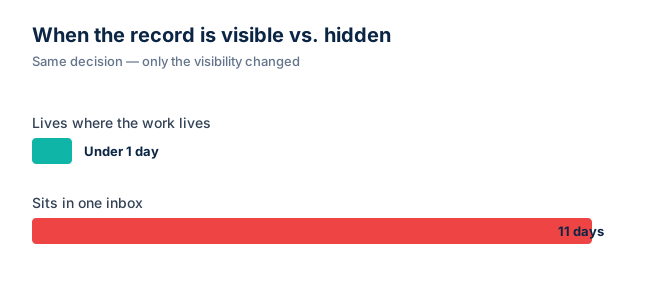
Funded is not the same as finished
Put plainly, an audit-ready project keeps these together from day one:
The contract and its change orders. The original plus every amendment, in order, with nothing living only in an email thread.
Procurement justification. Why this vendor, this price, this process — documented at the time, not rationalized after.
Meeting minutes and direction. Especially anything that changed scope, schedule, or budget.
Invoices matched to the contract. Each dollar paid, tied to the commitment that authorized it.
The decision record. Who approved what, when, and on what basis — captured as it happened, not reconstructed under pressure.
What changes the outcome isn't heroics at audit time. It's removing the gap between doing the work and recording it.
That is exactly what XNM-VISION is built to do. It keeps capital projects and the records that prove them in one auditable system — approvals, versions, contracts, and change orders, each with a name and a date attached.
The payoff for non-profits is calm. When a question comes, the answer is already assembled — approval, version, and justification side by side — so a review becomes a search, not a scramble.
Being delivery-ready early — with the record built in from day one — is the quiet advantage. It doesn't make headlines, but it's the difference between a project that finishes and one that stalls.
Where the work actually gets stuck
The pattern is consistent across capital programs. The first cost is not the budget — it is the time spent reconstructing what already happened. A status meeting becomes an archaeology session. A funder question turns into a two-week scavenger hunt. The people doing the real work end up doing the proving twice.
Consider a typical scenario: a community planner needs to confirm that a change order was authorized before an invoice clears. The contract is in a shared drive, the approval is in someone's inbox, the invoice is in the accounting system, and the photo of the as-built condition is on a phone. Each piece exists. None of them point at each other. That gap — not the missing document, but the missing link — is what audits, disputes, and refinancing conversations expose.
Most teams react by adding more discipline: another tracker, another weekly sync, another folder convention. It works for a quarter and then drifts, because the discipline lives in people's heads rather than in the record itself. The fix is structural: make the record the workspace, so doing the work and proving the work are the same motion.
The teams that consistently come through audits clean are not the teams with the most controls. They are the teams whose record is naturally complete because the tools they used to do the work also wrote the trail. That is a design choice, not a virtue.
In practice, three habits separate audit-ready programs from the rest. First, every document is attached to the decision it supports, not just stored in a folder. Second, every approval carries a name, a date, and the version it approved — not a generic "approved" stamp. Third, every dollar is traceable from the contract that authorized it through the change orders that modified it to the invoices that drew it down.
A practical playbook you can run this quarter
Adopt a single record per project. One place where the contract, the approvals, the invoices, the change orders, and the as-built evidence sit together, with version history that you do not have to curate.
Make approvals carry weight. Every gate gets a name, a date, and the exact version that was approved. No more arguing about which draft was signed off.
Tie every dollar to its authorization. Invoices link to the contract or change order that justified them, so reconciliation is a click rather than a forensic exercise.
Run the same report you would hand a funder. If the report you use internally is the report your funder, your auditor, and your board would see, surprises shrink.
Treat the record as the workspace. If proving the work is a separate motion from doing it, the proof will always lag. If they are the same motion, the record stays current automatically.
Status meetings get shorter because nobody is reconstructing the last two weeks.
Audits stop feeling like emergencies and start feeling like exports.
New team members ramp in days instead of months because the project explains itself.
Disputes get resolved on facts that everyone can see at the same time.
Funders ask harder questions less often because the easy questions answer themselves.
None of this requires heroics. It requires that the system you work in is also the system you would defend in a hearing. The teams who get there stop spending evenings assembling decks and start spending mornings making decisions.
How XNM-VISION changes the day-to-day
The XNM-VISION records engine is built around exactly that idea. The contract, the version, the approval, the invoice, and the photo of the work do not just coexist — they reference each other. When a funder calls, the answer is already a link. When an audit lands, the export already exists. When a dispute opens, the timeline is already a timeline.
That is the quiet shift behind audit-ready programs: not more rigor, but rigor that lives in the tools rather than the people. The work is the same. The proof is automatic.
XNM has helped public-sector and capital teams make audit-ready their normal state since 2013. See how XNM-VISION works.