A Field Guide to Audit-Ready Capital projects for Project teams

Ask anyone running permits, drawings, contracts, and change orders what kept them up in 2024, and the federal housing-supply push is only half the answer. The other half is quieter: the fear of not being able to find the one record that settles a question.
What's really at risk isn't tidiness. It's whether a funder, an auditor, or a partner can look at your project and trust that it was run the way you say it was.
Funded is not the same as finished
Project teams rarely fail for lack of effort. They fail because the proof is scattered — a sign-off here, an invoice there, a change order in a thread no one can find under pressure.
It compounds over time. Every handoff between project teams and their partners is a chance for a version to fork, an approval to go unrecorded, or a commitment to survive only in someone's memory.
Consider how this plays out for project teams in practice. A decision gets made in a meeting, refined over a few emails, approved with a nod, and then executed by a crew who never saw any of it written down. Months later — often once the federal housing-supply push has put every project under a brighter light — someone asks a question that should be easy: show me where this was approved, and by whom. The work itself was sound. The trail behind it was not. And it is precisely in that gap, between a good decision and a provable one, that budgets quietly disappear and schedules slip.
Where most programs lose time
There is a predictable place where programs leak hours: the handoff between people who made a decision and the people who must execute or report on it. The decision sits in someone's head, or in a thread, or in a meeting note that was never circulated. The executor reconstructs from fragments. The reporter calls both of them.
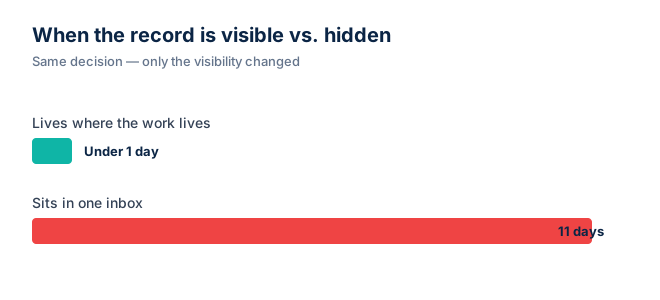
When the underlying record is named, dated, owned, and visible, the handoff stops costing hours. The executor reads the record. The reporter reads the record. The original decider keeps working. No one is interrupted to explain something that was already written down.
Capture at the source. The person who made the decision writes the one-line summary, not the person who heard about it third-hand.
Link to the document. The decision points at the exact version it was based on, not a folder.
Name an owner. One person is accountable for keeping the record current as facts change.
Set a review date. Records that are never re-checked drift; a small recurring review keeps them honest.
How XNM-VISION changes the day-to-day
The practical change inside a team using XNM-VISION is small but cumulative. Decisions are written where the documents already live. Versions are not a question of memory. Permissions are tied to role, so the right people see the right things without anyone having to remember to share. Over a quarter, the meetings that existed only to reconstruct context simply stop being scheduled.
That is the quiet outcome of records-as-infrastructure: the team gets time back, and the reviewer gets answers instead of a tour of the file system.
A short, practical checklist
The usual suspects, every time:
A funder's reporting requirement nobody mapped to a document
An approval that exists but isn't visible to the work
A commitment made in a meeting and never written down
The one attachment that proves the whole timeline
What the federal housing-supply push actually changes
Put plainly, an audit-ready project keeps these together from day one:
Approvals and sign-offs. Every gate with a name and date attached, visible to everyone the decision touches.
Invoices matched to the contract. Each dollar paid, tied to the commitment that authorized it.
The contract and its change orders. The original plus every amendment, in order, with nothing living only in an email thread.
Meeting minutes and direction. Especially anything that changed scope, schedule, or budget.
The decision record. Who approved what, when, and on what basis — captured as it happened, not reconstructed under pressure.
None of this is a discipline problem. Diligent people lose records every day. It's a structure problem — and structure is fixable.
With the XNM-VISION records engine, project teams stop hunting. The approval, the current version, and the justification sit together with a full trail — visible to everyone the decision touches, on a clock anyone can see.
Teams stand it up fast: the XNM-VISION records engine deploys in days, not the months a traditional system takes, and it carries unlimited users, so every partner, reviewer, and field lead works from the same picture.
Funding gets you to the starting line. Records are what carry you across it. In a year defined by the federal housing-supply push, that distinction is the whole game.
Before any new initiative starts, run a five-minute test on the records that will support it. Can you point to the canonical version of the scope, the budget, the schedule, and the approvals — each in one place, each with a date and an owner? If any of the four is missing, fix that before the work begins; you will not have a calmer time to fix it later.
This is not paperwork for its own sake. It is the foundation that lets the work actually move. A team that can answer the four questions in under a minute is a team that gets to spend its time on the project, not on the search for the project.
Want to see what one source of truth looks like for your projects? Talk to us — it's a short conversation.