A Field Guide to Audit-Ready Capital projects for Developers
Through 2024, developers watched Budget 2024's Indigenous Loan Guarantee Program move money and attention toward big builds. The capital is the easy part. The hard part shows up later, in whether you can prove what you decided and when.
The stakes are simple. When you can't show a decision, you don't just lose an argument — you lose time, money, and the benefit of the doubt, usually all at once.
Make ready your resting state
Most developers are managing pro formas, draws, and a wall of contracts across email, spreadsheets, and three or four tools that don't talk to each other. The information exists. It just can't be assembled when it counts.
Look closer at any developers and the same fault line appears: the people doing the work and the people who must answer for it are reading from different copies. One has the latest drawing; the other has last month's.
Picture the opposite, just for a moment. A capital project where every approval, version, and dollar lands in one place as it happens, each stamped with a name and a date, visible to everyone the work touches. When a funder calls or an auditor schedules a review, nothing has to be reconstructed — the answer is already there, assembled by the act of doing the work. For developers, that is not a fantasy or a bigger budget; it is a different default. And in an era defined by Budget 2024's Indigenous Loan Guarantee Program, that default is quietly becoming the line between the teams that deliver and the teams that stall.
What a "clean record" actually looks like
Teams often agree they want a 'clean record' without agreeing on what that means. In practice it is narrower than people think. A clean record can answer four questions in under a minute: what was decided, who decided it, when it became effective, and what version of the document the decision pointed to. If any of those four require a phone call, the record is not yet clean.
Most of the work to get there is not technical. It is naming and placement. A document that lives in three folders with three slightly different names cannot serve as proof. A document that lives in one place, with one canonical name, one owner, and a date, can survive any review.
A single canonical location, not a copy in every inbox
A name that reads the same to a clerk, an auditor, and a partner
A status that is current, superseded, or draft — never ambiguous
A small change log that explains why this version replaced the last
The cost of "we will sort it later"
The phrase 'we will sort it later' usually means the work will be done twice: once now under deadline, and once again when someone asks for proof. The second pass is the expensive one because the people who made the original decision have moved on, the context is gone, and the burden of reconstruction falls on whoever happens to be in the room.
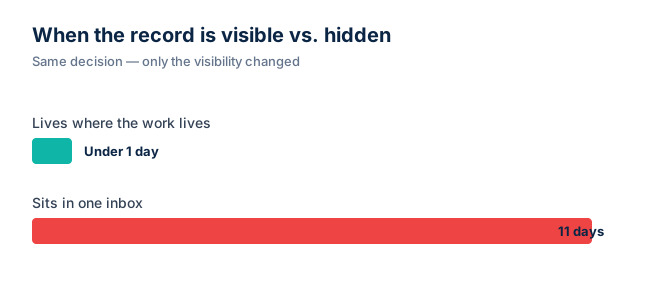
A record that is built as the work happens — not after — turns that second pass into a lookup. The question stops being 'can we find it?' and becomes 'who needs to see it?' That is the shift that pays for itself within a single review cycle.
How XNM-VISION helps
These are the records that go missing first:
Which version of the budget is the real one
Whether a scope change was ever formally approved
The minutes where direction actually changed
Closeout proof of what was delivered and who signed for it
Make ready your resting state
These are the records that turn a hard question into a two-minute answer:
Meeting minutes and direction. Especially anything that changed scope, schedule, or budget.
Invoices matched to the contract. Each dollar paid, tied to the commitment that authorized it.
Approvals and sign-offs. Every gate with a name and date attached, visible to everyone the decision touches.
The contract and its change orders. The original plus every amendment, in order, with nothing living only in an email thread.
Version history. Proof of which drawing, spec, or policy was current on any given day.
The fix isn't 'try harder.' It's to stop keeping the record separate from the work, so the proof accumulates on its own.
XNM-VISION turns the scattered exhaust of a project into a single auditable record. For developers, that means a partner, funder, or auditor can be answered in minutes, not weeks.
Crucially, XNM-VISION doesn't ask developers to change how they work. It sits on top of the sources you already have, turning scattered effort into one auditable trail without a migration project.
The money will keep flowing toward big builds. The teams that win the next decade won't be the ones who got funded — they'll be the ones who could prove, on any given Tuesday, exactly how the work was run.
XNM-VISION sits underneath the work as the records layer. Documents, decisions, approvals, and version history live in one place, with role-based access so the right people see the right things. Audit trails are produced as a by-product of normal work, not assembled at the end of the quarter. When a funder, board member, or partner asks a question, the answer is one search away — and it points at a specific document, not a folder.
The platform deploys quickly, fits the tools teams already use, and scales from a single capital project to a portfolio without changing how people work day-to-day. That is the practical promise: less time on the search, more time on the work.
Want to see what one source of truth looks like for your projects? Talk to us — it's a short conversation.