Why tighter scrutiny of provincial capital plans Puts Health authorities on the Clock

Tighter scrutiny of provincial capital plans made one thing clear in 2024: getting capital projects approved is no longer the bottleneck. Delivering them — and being able to show your work — is.
What's really at risk isn't tidiness. It's whether a funder, an auditor, or a partner can look at your project and trust that it was run the way you say it was.
The decision wasn't wrong — it was invisible
The real problem for health authorities isn't missing information — it's unfindable information. The approval, the version, the justification all exist; they just don't live where the work can see them.
And it bites hardest exactly when it matters most. The day a funder calls, the week an audit lands, the moment a dispute starts — that is when health authorities learn which records they can actually produce and which they only thought they had.
It helps to name the real adversary, because it is not incompetence. For health authorities, the adversary is entropy — the natural tendency of a busy project to scatter its own evidence across people, tools, and time until no single place holds the whole truth. Every reorganization, every staff change, every 'we'll clean it up later' feeds it. Tighter scrutiny of provincial capital plans did not create this problem, but it raised the cost of it, because more scrutiny means more moments when scattered evidence has to be pulled back together at speed. Structure is the only thing that reliably beats entropy.
In practice, the gaps cluster in a few familiar places:
The decision record — who approved what, when, and on what basis
Invoices matched to the contract that authorized them
The procurement justification, documented at the time
Version history proving which drawing was current on a given day
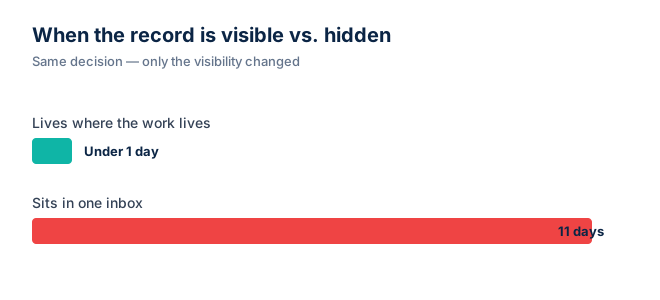
Make ready your resting state
Put plainly, an audit-ready project keeps these together from day one:
Invoices matched to the contract. Each dollar paid, tied to the commitment that authorized it.
Closeout and retention. What was delivered, who signed for it, and proof you kept what you must keep.
Meeting minutes and direction. Especially anything that changed scope, schedule, or budget.
The contract and its change orders. The original plus every amendment, in order, with nothing living only in an email thread.
Version history. Proof of which drawing, spec, or policy was current on any given day.
What changes the outcome isn't heroics at audit time. It's removing the gap between doing the work and recording it.
XNM-VISION closes that gap for health authorities. Every decision, document, and dollar lives in one place, captured as the work happens, so 'audit-ready' is your resting state rather than a sprint.
Teams stand it up fast: XNM-VISION deploys in days, not the months a traditional system takes, and it carries unlimited users, so every partner, reviewer, and field lead works from the same picture.
Being delivery-ready early — with the record built in from day one — is the quiet advantage. It doesn't make headlines, but it's the difference between a project that finishes and one that stalls.
What this looks like on a real project
Picture a mid-size capital project: a community building, a water upgrade, a fleet renewal. The funding flows in tranches, the scope shifts once or twice as conditions change, and a handful of subcontractors come and go. None of that is unusual. The trouble starts when each shift lives in a different inbox or shared drive, and nobody is fully sure which copy is the one the steering committee actually approved.
Inside three months you have parallel realities: the plan in the contract, the plan in the latest email, and the plan the crew is actually building. Each is defensible in isolation. None of them line up at audit time, and the team is left re-assembling the timeline from memory and screenshots.
Teams that stay calm under that pressure do one quiet thing differently. They treat the record as a side-effect of the work, not a separate chore. The approval and the proof of the approval land in the same place at the same time, and the question “where is that?” simply stops being a meeting.
The small habits that compound
Every decision is logged the day it is made, not the week after
Every invoice is tied to the contract line that authorized it
Every change order references the prior version it supersedes
Every meeting that moves a number ends with that number written down
How XNM-VISION turns the test into a non-event
In practice, the cure is not a heroic clean-up effort the week before review. It is a quiet operating habit, supported by a system that refuses to let work and record drift apart. That is what XNM-VISION is built to do.
Capture once, reuse everywhere. An approval recorded once becomes the citation for the invoice, the change order, and the audit response without anyone re-keying it.
Versioned by default. Every drawing, spec, and policy keeps its own dated history, so “which one was current” is a query, not a debate.
Linked to the dollars. Contracts, invoices, and payments share a thread, and the budget view inherits that thread automatically.
Searchable in plain language. Staff who were not in the room can find the right document in seconds and trust that it is the right one.
The result is unglamorous and very valuable. When the question arrives — from a funder, an auditor, a council, or a board — the answer is one link, not one more scramble.
Want to see what one source of truth looks like for your projects? Talk to us — it's a short conversation.