Why the drive to modernize public-sector records Puts Utilities on the Clock

Every utility we talk to has the same 2026 story. The drive to modernize public-sector records raised the stakes, the project got bigger, and the paperwork that proves it got harder to keep straight.
What's really at risk isn't tidiness. It's whether a funder, an auditor, or a partner can look at your project and trust that it was run the way you say it was.
What the drive to modernize public-sector records actually changes
Utilities rarely fail for lack of effort. They fail because the proof is scattered — a sign-off here, an invoice there, a change order in a thread no one can find under pressure.
It compounds over time. Every handoff between utilities and their partners is a chance for a version to fork, an approval to go unrecorded, or a commitment to survive only in someone's memory.
Picture the opposite, just for a moment. A capital projects where every approval, version, and dollar lands in one place as it happens, each stamped with a name and a date, visible to everyone the work touches. When a funder calls or an auditor schedules a review, nothing has to be reconstructed — the answer is already there, assembled by the act of doing the work. For utilities, that is not a fantasy or a bigger budget; it is a different default. And in an era defined by the drive to modernize public-sector records, that default is quietly becoming the line between the teams that deliver and the teams that stall.
These are the records that go missing first:
The current drawing, versus three that look almost identical
The signed copy, versus the draft everyone kept editing
The retention proof that you kept what you must keep
The single thread that explains why a number changed
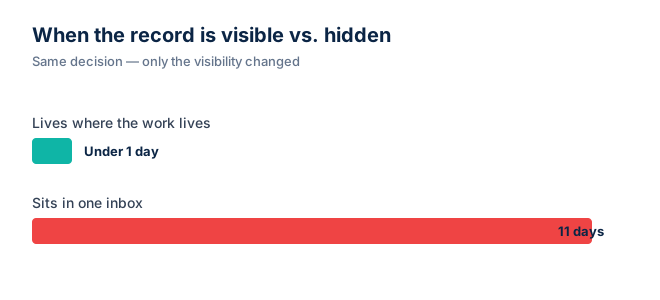
Where the proof goes to hide
The short list of what should never be left scattered:
Closeout and retention. What was delivered, who signed for it, and proof you kept what you must keep.
The decision record. Who approved what, when, and on what basis — captured as it happened, not reconstructed under pressure.
The contract and its change orders. The original plus every amendment, in order, with nothing living only in an email thread.
Procurement justification. Why this vendor, this price, this process — documented at the time, not rationalized after.
Approvals and sign-offs. Every gate with a name and date attached, visible to everyone the decision touches.
The fix isn't 'try harder.' It's to stop keeping the record separate from the work, so the proof accumulates on its own.
That is exactly what one auditable system is built to do. It keeps capital projects and the records that prove them in one auditable system — approvals, versions, contracts, and change orders, each with a name and a date attached.
And it scales with the work, not the headcount: from a single capital projects to a whole portfolio, the record stays consistent, current, and provable on demand.
The lesson repeats across every sector. You don't survive scrutiny by preparing for it. You survive by never being in a position that needs preparing.
What this looks like in practice
Picture a quarterly steering meeting where the finance lead, the project manager and the records officer pull up the same screen. The contract value, the approved change orders, the invoices paid to date and the next two milestone payments all sit side by side, with a link to every supporting document. No one has to send a follow-up email to "find the latest version." The conversation skips the bookkeeping and goes straight to the decision: do we accelerate, hold, or rescope?
Now picture the alternative most teams live in today. The finance number comes from a spreadsheet last refreshed three weeks ago. The schedule lives in a PDF a contractor emailed in. The change order is in someone's inbox. The meeting spends forty minutes reconciling the gap before anyone can decide anything. Multiply that across a dozen capital projects and a year of board cycles and the cost is not hard to see.
The difference between those two meetings is not talent or budget. It is whether the records were captured at the moment work happened, or reconstructed afterward from memory and inbox archaeology.
A practical playbook to tighten the loop
Name a single source of truth per project. Pick the system, write down which fields are authoritative, and stop accepting numbers from anywhere else in formal reporting.
Capture the receipt, not just the result. Every contract value, every change order, every invoice payment is logged against the project record with the source document attached.
Make access boring. Tiered permissions, named owners, no shared inboxes. Anyone with a question should be able to find the answer in under a minute.
Close the loop on closeout. Warranties, lien releases, as-built drawings and final payments belong in the same place as the original budget, not a separate archive nobody opens.
Adopting that playbook is not glamorous, but it is the difference between a project that quietly compounds knowledge and a project that quietly compounds risk. Most teams discover, six months in, that the cost of catching up is much higher than the cost of starting clean.
Why this matters beyond a single project
Every project a public-sector or capital-intensive organisation runs is also a precedent. The next contract, the next funder, the next audit will all benchmark against how the last one was documented. Teams that build the record as they go inherit credibility; teams that scramble at the end inherit doubt, regardless of whether the underlying work was excellent.
Funders and auditors compare your current paper trail to the one you produced last time.
Staff turnover stops being a crisis when the institutional memory lives in the system, not in one person's head.
Board reporting takes hours instead of weeks, because the underlying numbers are already reconciled.
Disputes shrink because the contemporaneous record is stronger than anyone's recollection.
That is the quiet compounding effect of doing records well. It does not show up on a single project P&L, but it shows up in how much faster the next project starts, and how much less time leadership spends defending decisions that were perfectly defensible all along.
XNM-VISION is built on exactly that premise: that the records discipline is the project-controls discipline, and the two cannot be separated without paying for it later. Wiring the capture into daily work, rather than bolting it on at the end, is what turns a portfolio from anxious to predictable.
XNM has helped public-sector and capital teams make audit-ready their normal state since 2013. See how XNM-VISION works.