Why the 2024 fall fiscal update Puts Mine operators on the Clock

Ask anyone running permitting, community agreements, and closure obligations what kept them up in 2024, and the 2024 fall fiscal update is only half the answer. The other half is quieter: the fear of not being able to find the one record that settles a question.
The quiet truth is that most overruns aren't decisions gone wrong. They're decisions that went fine but couldn't be proven, defended, or found in time.
Make ready your resting state
Mine operators rarely fail for lack of effort. They fail because the proof is scattered — a sign-off here, an invoice there, a change order in a thread no one can find under pressure.
And it bites hardest exactly when it matters most. The day a funder calls, the week an audit lands, the moment a dispute starts — that is when mine operators learn which records they can actually produce and which they only thought they had.
It helps to name the real adversary, because it is not incompetence. For mine operators, the adversary is entropy — the natural tendency of a busy project to scatter its own evidence across people, tools, and time until no single place holds the whole truth. Every reorganization, every staff change, every 'we'll clean it up later' feeds it. The 2024 fall fiscal update did not create this problem, but it raised the cost of it, because more scrutiny means more moments when scattered evidence has to be pulled back together at speed. Structure is the only thing that reliably beats entropy.
The usual suspects, every time:
Which version of the budget is the real one
Whether a scope change was ever formally approved
The minutes where direction actually changed
Closeout proof of what was delivered and who signed for it
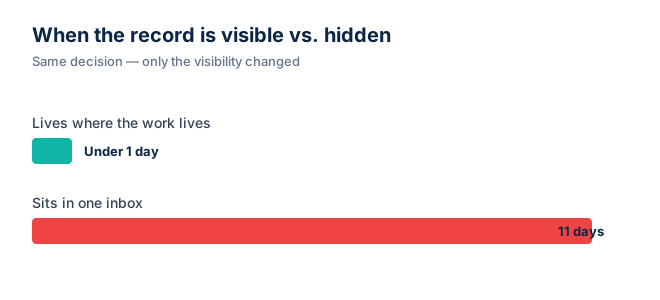
Funded is not the same as finished
Here is what belongs in one place, with a name and a date on every item:
Closeout and retention. What was delivered, who signed for it, and proof you kept what you must keep.
Procurement justification. Why this vendor, this price, this process — documented at the time, not rationalized after.
Meeting minutes and direction. Especially anything that changed scope, schedule, or budget.
The contract and its change orders. The original plus every amendment, in order, with nothing living only in an email thread.
The decision record. Who approved what, when, and on what basis — captured as it happened, not reconstructed under pressure.
The fix isn't 'try harder.' It's to stop keeping the record separate from the work, so the proof accumulates on its own.
That is exactly what XNM-VISION is built to do. It keeps capital projects and the records that prove them in one auditable system — approvals, versions, contracts, and change orders, each with a name and a date attached.
And it scales with the work, not the headcount: from a single capital projects to a whole portfolio, the record stays consistent, current, and provable on demand.
The money will keep flowing toward big builds. The teams that win the next decade won't be the ones who got funded — they'll be the ones who could prove, on any given Tuesday, exactly how the work was run.
What this looks like on a real project
Picture a mid-size capital project: a community building, a water upgrade, a fleet renewal. The funding flows in tranches, the scope shifts once or twice as conditions change, and a handful of subcontractors come and go. None of that is unusual. The trouble starts when each shift lives in a different inbox or shared drive, and nobody is fully sure which copy is the one the steering committee actually approved.
Inside three months you have parallel realities: the plan in the contract, the plan in the latest email, and the plan the crew is actually building. Each is defensible in isolation. None of them line up at audit time, and the team is left re-assembling the timeline from memory and screenshots.
Teams that stay calm under that pressure do one quiet thing differently. They treat the record as a side-effect of the work, not a separate chore. The approval and the proof of the approval land in the same place at the same time, and the question “where is that?” simply stops being a meeting.
The small habits that compound
Every decision is logged the day it is made, not the week after
Every invoice is tied to the contract line that authorized it
Every change order references the prior version it supersedes
Every meeting that moves a number ends with that number written down
How XNM-VISION turns the test into a non-event
In practice, the cure is not a heroic clean-up effort the week before review. It is a quiet operating habit, supported by a system that refuses to let work and record drift apart. That is what XNM-VISION is built to do.
Capture once, reuse everywhere. An approval recorded once becomes the citation for the invoice, the change order, and the audit response without anyone re-keying it.
Versioned by default. Every drawing, spec, and policy keeps its own dated history, so “which one was current” is a query, not a debate.
Linked to the dollars. Contracts, invoices, and payments share a thread, and the budget view inherits that thread automatically.
Searchable in plain language. Staff who were not in the room can find the right document in seconds and trust that it is the right one.
The result is unglamorous and very valuable. When the question arrives — from a funder, an auditor, a council, or a board — the answer is one link, not one more scramble.
If your last review felt like a fire drill, that's a records problem, not a character flaw — and a solvable one. See how teams make ready their resting state with XNM-VISION.