Why Capital Plans Fail at Delivery, Not Design

Almost no capital plan fails on the page. The business case was sound, the budget was defensible, the schedule was achievable, and everyone in the room approved it. Two years later it is over budget, behind schedule, and nobody can quite say when it went wrong. The plan did not fail. The delivery did — and, quietly, so did the paperwork that was supposed to keep delivery honest.
This is the most expensive misdiagnosis in capital projects: treating overruns as a planning problem and pouring ever more effort into better plans, when the value was actually lost downstream, in the long grind of execution and the records that go with it. If you want to fix delivery, you have to look where delivery actually breaks.
Where the value leaks out
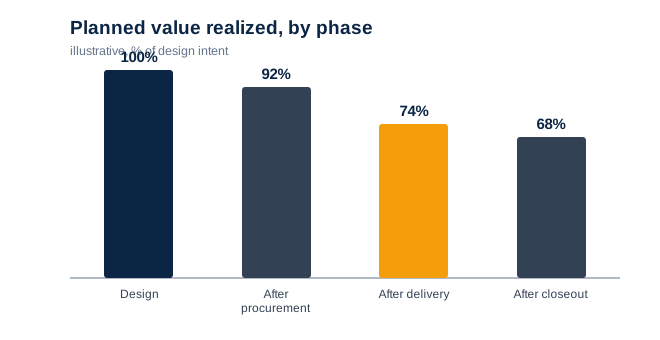
Picture a plan as a hundred units of intended value, approved at design. Very little of it is lost in the planning itself. The leaks come later, phase by phase — and each one is a documentation failure as much as an execution one:
Procurement drift. Scope gets reinterpreted between the plan and the contracts. What was approved and what was actually bought quietly diverge, and no single record reconciles them.
Delivery entropy. Decisions get made in the field faster than they get recorded. Change orders lag, approvals scatter, and the project's real state stops matching any document.
The information gap. The people executing cannot quickly find the current drawing, the latest approval, or the reason behind a past decision — so they re-decide, re-work, and re-litigate things that were already settled.
Closeout debt. The records that should have been captured all along get deferred to the end, where they are expensive, incomplete, or simply never finished.
Notice that none of these are failures of the plan. They are failures of the connective tissue between the plan and the built thing — and that tissue is mostly information.
Fix delivery by fixing the record
The counterintuitive lever is this: the fastest way to improve delivery is not a better plan or a bigger team — it is a project whose real state is always documented and always findable. When the current drawing, the latest approval, the open decisions, and the actual spend all live in one place everyone trusts, execution stops leaking. People stop re-deciding. Drift gets caught in weeks instead of quarters. The plan and the built thing stay in conversation instead of drifting into two separate stories that only get reconciled, painfully, at the end.
So before you invest in another round of better planning, ask a harder question about your last overrun: was the plan actually wrong, or did you simply lose the thread during delivery and only discover it at closeout? For most capital projects, most of the time, it is the second one. Great plans do not die in the boardroom. They die in the months afterward, in a thousand small decisions nobody wrote down — and that, unlike a forecast, is a failure you can actually prevent.
The plan was probably fine. The real question is whether your delivery leaves a record honest enough to prove it. More on capital delivery and project records every week on the XNM blog.