Why Bill C-5 and the new Major Projects Office Puts Project teams on the Clock
When Bill C-5 and the new Major Projects Office dominated the headlines in 2025, project teams felt the pressure shift. The era of arguing for funding is giving way to a harder era of accounting for it.
And the bill always comes due at the worst moment: mid-build, mid-audit, or mid-dispute, when the missing piece is suddenly the only piece that matters.
What Bill C-5 and the new Major Projects Office actually change
The pattern is familiar to project teams: each system holds a piece of the truth, no system holds all of it, and the gaps between them are exactly where projects quietly bleed.
Look closer at any project teams and the same fault line appears: the people doing the work and the people who must answer for it are reading from different copies. One has the latest drawing; the other has last month's.
There is a reason this keeps happening even to careful project teams. The tools that hold the work — email, shared drives, spreadsheets, a project app or two — were each built to do one job well, not to keep a single, time-stamped record of what was decided and why. So the record becomes a manual chore bolted onto the real work, and it is the first thing to slip when permits, drawings, contracts, and change orders gets busy. In a year shaped by Bill C-5 and the new Major Projects Office, that one dropped chore is exactly what returns, months later, as a finding, a dispute, or a number nobody can explain.
Here is where the proof tends to hide:
The decision record — who approved what, when, and on what basis
Invoices matched to the contract that authorized them
The procurement justification, documented at the time
Version history proving which drawing was current on a given day
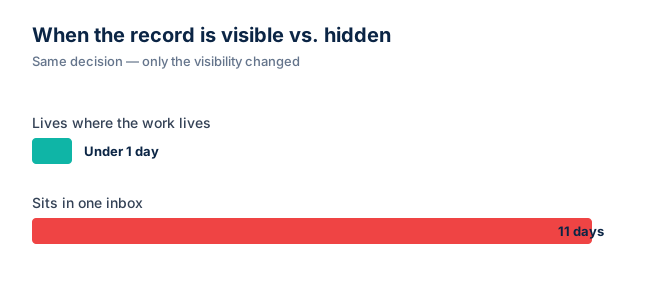
The records that settle questions
These are the records that turn a hard question into a two-minute answer:
Closeout and retention. What was delivered, who signed for it, and proof you kept what you must keep.
The contract and its change orders. The original plus every amendment, in order, with nothing living only in an email thread.
The decision record. Who approved what, when, and on what basis — captured as it happened, not reconstructed under pressure.
Meeting minutes and direction. Especially anything that changed scope, schedule, or budget.
Procurement justification. Why this vendor, this price, this process — documented at the time, not rationalized after.
The way out is not more effort. It's a single place where the decision, the document, and the work are the same object.
XNM-VISION closes that gap for project teams. Every decision, document, and dollar lives in one place, captured as the work happens, so 'audit-ready' is your resting state rather than a sprint.
And it scales with the work, not the headcount: from a single capital projects to a whole portfolio, the record stays consistent, current, and provable on demand.
Funding gets you to the starting line. Records are what carry you across it. In a year defined by Bill C-5 and the new Major Projects Office, that distinction is the whole game.
Where the audit risk actually sits
Picture a typical week on a mid-sized capital file. A change directive is issued in a Tuesday meeting, a revised drawing arrives Thursday from the engineer, an invoice referencing the new scope lands the following Monday, and a funder requests proof of approval three weeks later. Four different people touched four different systems. The decision was sound. The trail is not.
Most teams already understand the work. What slips is the connective tissue: who approved which version, which line item that invoice maps to, which minute authorised the substitution, which letter sets the obligation. None of it is unknowable. All of it is scattered.
Approvals living in email rather than against the document
Two slightly different copies of the same contract on two shared drives
A meeting decision that nobody translated into a change order
A regulatory obligation tracked in a spreadsheet that one person updates
A vendor submittal accepted in conversation but never recorded
Multiply that across a portfolio and the picture gets sharper. The overrun is not the surprise; the surprise is how predictable it was once you could see the gaps. The same three or four records keep going missing across files, across years, across teams.
What changes once the records stop hunting you
The fix is not heroic. It is structural. When the record of the decision lives in the same place as the work product the decision authorised, the team stops re-litigating the past and gets back to running the present.
Capture the decision where it happens. A note in the minute, a change in scope, an approval against a version — all in the file, not in someone's inbox.
Bind the document to the decision. The drawing, the invoice, the report sit alongside the approval that made them current.
Make the obligation visible. Every funder condition, regulatory commitment, and contractual deliverable has a named owner and a due date everyone can see.
Keep the trail walkable. A reviewer can move from question to answer in clicks, not interviews.
None of this is glamorous. That is the point. The teams that look unflappable at review are the ones that made the boring choices early and stuck with them.
What good looks like, in a single Wednesday
On the right Wednesday, the team is not preparing for anything in particular. They are doing the work. A change request comes in and is logged against the right line item. A deliverable is uploaded and the version is clear. A funder asks a question and the answer is two clicks away. That is the bar.
The shift is not from manual to automated. It is from scattered to single. One place, one current version, one trail that holds up when somebody asks.
If your last review felt like a fire drill, that's a records problem, not a character flaw — and a solvable one. See how teams make ready their resting state with XNM-VISION.