The Records Test: Could Provincial agencies Prove It Tomorrow?

Progress reports on closing the infrastructure gap made one thing clear in 2026: getting capital projects approved is no longer the bottleneck. Delivering them — and being able to show your work — is.
What's really at risk isn't tidiness. It's whether a funder, an auditor, or a partner can look at your project and trust that it was run the way you say it was.
The records that settle questions
provincial agencies rarely fail for lack of effort. They fail because the proof is scattered — a sign-off here, an invoice there, a change order in a thread no one can find under pressure.
And it bites hardest exactly when it matters most. The day a funder calls, the week an audit lands, the moment a dispute starts — that is when provincial agencies learn which records they can actually produce and which they only thought they had.
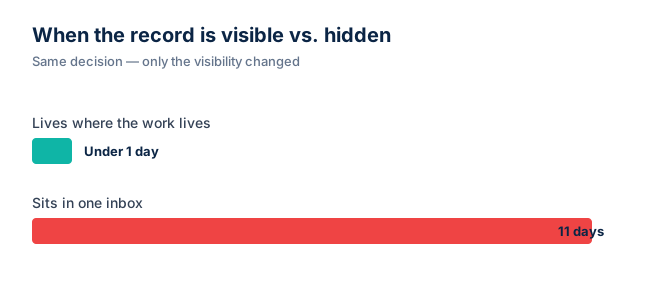
Picture the opposite, just for a moment. A capital projects where every approval, version, and dollar lands in one place as it happens, each stamped with a name and a date, visible to everyone the work touches. When a funder calls or an auditor schedules a review, nothing has to be reconstructed — the answer is already there, assembled by the act of doing the work. For provincial agencies, that is not a fantasy or a bigger budget; it is a different default. And in an era defined by progress reports on closing the infrastructure gap, that default is quietly becoming the line between the teams that deliver and the teams that stall.
Here is where the proof tends to hide:
A funder's reporting requirement nobody mapped to a document
An approval that exists but isn't visible to the work
A commitment made in a meeting and never written down
The one attachment that proves the whole timeline
The records that settle questions
Put plainly, an audit-ready project keeps these together from day one:
Procurement justification. Why this vendor, this price, this process — documented at the time, not rationalized after.
Meeting minutes and direction. Especially anything that changed scope, schedule, or budget.
Version history. Proof of which drawing, spec, or policy was current on any given day.
Invoices matched to the contract. Each dollar paid, tied to the commitment that authorized it.
The decision record. Who approved what, when, and on what basis — captured as it happened, not reconstructed under pressure.
What changes the outcome isn't heroics at audit time. It's removing the gap between doing the work and recording it.
This is the problem XNM-VISION was designed around: one source of truth for multi-year capital plans across many sites, ingesting from the inboxes and folders you already use, so nothing has to be reassembled later.
The payoff for provincial agencies is calm. When a question comes, the answer is already assembled — approval, version, and justification side by side — so a review becomes a search, not a scramble.
Being delivery-ready early — with the record built in from day one — is the quiet advantage. It doesn't make headlines, but it's the difference between a project that finishes and one that stalls.
What this looks like on the ground
Walk any active site and the issue is rarely strategy. It is the quiet tax of looking for things. A supervisor reaches for the right inspection report and finds three plausible versions across a shared drive, an email thread, and a phone camera roll. A finance lead reconciles an invoice against a contract that was amended twice and is sure only the second amendment is in the file. Each search costs minutes, the minutes become hours, and the hours become the reason a milestone slips.
The compounding effect is the part most operators underestimate. A single missing approval slows one decision. A pattern of missing approvals quietly trains the team to route around the system, copying files locally, screenshotting messages, and storing the truth in heads rather than in records. Once the truth lives in heads, every staff change is a risk event and every audit is a scramble.
The fix is unglamorous and durable. Make the resting state of the project so clean that any reasonable question can be answered in under a minute by someone who was not in the original meeting. That is the standard. Anything less is borrowed time.
A practical week to get current
If the last quarter felt like a constant catch-up, the way out is not heroics. It is a short, well-sequenced week of cleanup that pays back for the rest of the year.
Day one, name the spine. List the 8 to 12 record types the project actually depends on — approvals, decisions, contracts, change orders, invoices, inspections, correspondence of consequence, closeout items.
Day two, find one home for each. Move each type into a single location with a predictable naming pattern, so a newcomer can find the right folder without asking.
Day three, attach the proof. For every approval and every payment, link the document that authorizes it. No orphaned dollars, no orphaned decisions.
Day four, write the index. A one-page register that any team member can read in five minutes and find anything in another five.
Day five, test it cold. Ask someone outside the project to retrieve five specific items. Where they stall is your real backlog.
Why this matters more in 2026
The premium on delivery readiness has shifted what audits, funders, and boards actually ask for. The question is no longer 'did you do the work?' but 'can you show the work, end to end, without a phone call to the person who is on leave?' Programs that can answer yes tend to keep their funding profile intact. Programs that cannot tend to learn it the hard way during the next review window.
There is a quieter dividend, too. Calm. Teams that operate on a clean record stop spending their evenings reconstructing timelines and start spending them on the actual work — design choices, community engagement, sequencing decisions, the things that make a project good rather than merely defensible.
This is the work XNM-VISION was built to absorb. The records engine ties every approval, document, invoice, and change order to the decision it supports, so the resting state of the project is already audit ready. Nothing extra to assemble, nothing to reconstruct, and no single person whose absence stalls a review.
XNM has helped public-sector and capital teams make audit-ready their normal state since 2013. See how XNM-VISION works.