
The Purchase Agreement Is a Thirty-Year Record

When a utility signs a thirty-year electricity purchase agreement with an independent power producer, both sides are committing to more than the delivery of power. They are committing to a long run of evidence: that milestones were met, that the project was built as permitted, that ownership and benefit commitments were honoured, and that the plant still performs as promised in its third decade. For the owners of a new wind project, the purchase agreement is a revenue contract. It is also the start of a records obligation that will outlast most of the people who negotiated it.
Recent context
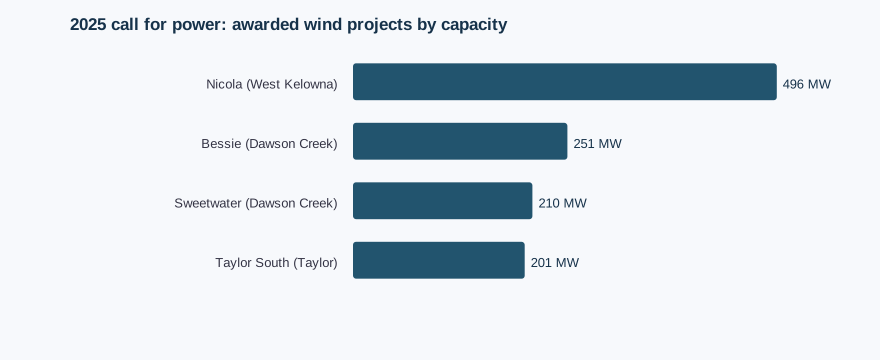
In May 2026, the B.C. government announced that BC Hydro is awarding thirty-year electricity purchase agreements to four wind projects from its 2025 call for power. According to the provincial news release, the call drew 14 proposals totalling more than 9,100 gigawatt hours per year, nearly double the targeted amount. The four selected projects will provide 3,500 gigawatt hours per year, boosting BC Hydro's current supply by 5%, and are expected to begin coming online as early as 2032, with all of them in service by October 2033.
The release lists the projects at between 201 and 496 megawatts each. Projects in the call had to include at least 25% First Nations equity ownership; all four successful projects will have 51%, which the province describes as more than $2 billion of ownership by First Nations. Each project will also provide non-equity benefits to two First Nations. The province expects as much as $4.3 billion in private capital spending and 1,500 jobs.
A long contract is a long file
Think about what one of these projects will have to prove over its life. In development, the file holds permits and their conditions, environmental studies, land tenure, interconnection studies and the partnership agreements that set out who owns what. In construction, it holds the contracts, drawings, change orders, inspection reports, test results and commissioning records. In operations, it holds three decades of performance data, outages, maintenance, component replacements and, eventually, decisions about life extension or repowering.
Many different parties will ask questions of that file. The utility will want evidence that milestones and commercial operation were reached as the agreement requires. Lenders will want to see that the asset is being maintained. First Nations partners, as majority owners, will want to see how decisions were made and how commitments to their communities are being kept. Auditors, regulators and, one day, a buyer of someone's stake will all want the same thing: a record they can follow without having to interview the people who were there.
Where wind project records come apart
The structure of these projects makes this harder than it looks.
- The partnership has several owners, and each tends to keep its own copy of the documents it cares about, so no single file is complete.
- The construction contractor and the turbine supplier hold much of the technical record, in their own systems, and hand over what the contract requires and little more.
- The development team that knew why each decision was made often moves to the next project soon after commercial operation.
- Benefit and employment commitments to First Nations are tracked in a spreadsheet that one person maintains, separate from the project file.
- Permit conditions are met in the field, but the evidence that they were met lives in field reports nobody has linked back to the condition.
None of this shows up in the first year. It shows up in year twelve, when a gearbox fails and nobody can find the original warranty terms, or when a partner asks how a cost overrun was approved and the answer is in an inbox that no longer exists.
A routine from award to year thirty
- Build the obligation register on day one. Go through the purchase agreement, the partnership agreement and every permit, and list each milestone, report, notice and condition with its due date and an accountable owner.
- Give the partnership one project file. Agree on a single system that all owners can see, with access for First Nations partners as owners rather than guests, and make it the place where final versions live.
- Tie evidence to obligations. When a permit condition is met or a milestone is reached, file the proof against that line in the register, not in a general folder.
- File every change against the contract and the drawing it changes. A change order should show what it modified, who approved it, what it cost and how it affected the schedule.
- Hand over deliberately at commercial operation. Before the construction team leaves, confirm that as-built drawings, commissioning records, warranties and turbine serial numbers are in the operations file.
- Keep operations on the same asset structure. Give every turbine, transformer and substation component an asset ID, and file maintenance, inspections and replacements against it for the life of the plant.
- Review the record with the partners once a year. Walk through open obligations, benefit commitments and gaps in the file while the people who can fill them are still around.
The power flows for thirty years
A wind project built for 2033 will still be delivering power in the 2060s. By then, the people who signed the agreement will have moved on and the partnership may have new members. What carries forward is the record. Keeping it in one auditable system, organized the same way from the first permit to the last turbine replacement, is how the owners make sure the project can always explain itself.