The 2025 Records Every One of Audit teams Should Stop Hunting For

Through 2025, audit teams watched fresh reporting on the national infrastructure deficit move money and attention toward big builds. The capital is the easy part. The hard part shows up later, in whether you can prove what you decided and when.
What's really at risk isn't tidiness. It's whether a funder, an auditor, or a partner can look at your project and trust that it was run the way you say it was.
Funded is not the same as finished
Audit teams rarely fail for lack of effort. They fail because the proof is scattered — a sign-off here, an invoice there, a change order in a thread no one can find under pressure.
The cost isn't only the missing document. It's the meeting to look for it, the second meeting to recreate it, and the slow erosion of trust every time someone has to say 'let me get back to you on that.'
Step back and the pattern is almost mechanical. Money arrives, ambition rises, the project grows — and the volume of decisions grows with it, faster than any inbox or folder can keep straight. For audit teams, the failure is rarely dramatic; it is a slow accumulation of small, unrecorded moments that only add up to a problem when someone with authority starts asking questions. Fresh reporting on the national infrastructure deficit is making that someone show up sooner, and more often. The teams that feel calm about it are not working harder — they simply never let the record and the work drift apart in the first place.
When a project gets questioned, these are the items everyone scrambles for:
The decision record — who approved what, when, and on what basis
Invoices matched to the contract that authorized them
The procurement justification, documented at the time
Version history proving which drawing was current on a given day
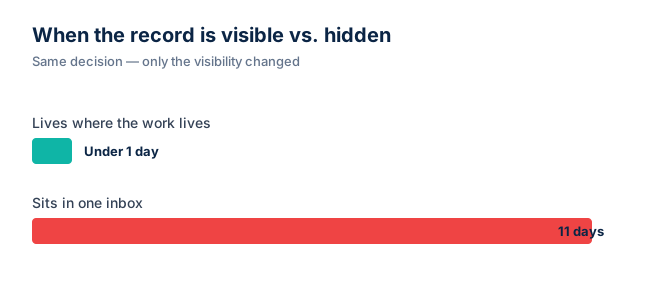
The decision wasn't wrong — it was invisible
These are the records that turn a hard question into a two-minute answer:
Procurement justification. Why this vendor, this price, this process — documented at the time, not rationalized after.
The decision record. Who approved what, when, and on what basis — captured as it happened, not reconstructed under pressure.
Approvals and sign-offs. Every gate with a name and date attached, visible to everyone the decision touches.
The contract and its change orders. The original plus every amendment, in order, with nothing living only in an email thread.
Invoices matched to the contract. Each dollar paid, tied to the commitment that authorized it.
The way out is not more effort. It's a single place where the decision, the document, and the work are the same object.
The XNM-VISION records engine closes that gap for audit teams. Every decision, document, and dollar lives in one place, captured as the work happens, so 'audit-ready' is your resting state rather than a sprint.
Crucially, the XNM-VISION records engine doesn't ask audit teams to change how they work. It sits on top of the sources you already have, turning scattered effort into one auditable trail without a migration project.
Fresh reporting on the national infrastructure deficit raised the ceiling on what's possible. Whether audit teams reach it comes down to something unglamorous: whether the proof was there all along.
What this looks like in practice
Picture a quarterly steering meeting where the finance lead, the project manager and the records officer pull up the same screen. The contract value, the approved change orders, the invoices paid to date and the next two milestone payments all sit side by side, with a link to every supporting document. No one has to send a follow-up email to "find the latest version." The conversation skips the bookkeeping and goes straight to the decision: do we accelerate, hold, or rescope?
Now picture the alternative most teams live in today. The finance number comes from a spreadsheet last refreshed three weeks ago. The schedule lives in a PDF a contractor emailed in. The change order is in someone's inbox. The meeting spends forty minutes reconciling the gap before anyone can decide anything. Multiply that across a dozen capital projects and a year of board cycles and the cost is not hard to see.
The difference between those two meetings is not talent or budget. It is whether the records were captured at the moment work happened, or reconstructed afterward from memory and inbox archaeology.
A practical playbook to tighten the loop
Name a single source of truth per project. Pick the system, write down which fields are authoritative, and stop accepting numbers from anywhere else in formal reporting.
Capture the receipt, not just the result. Every contract value, every change order, every invoice payment is logged against the project record with the source document attached.
Make access boring. Tiered permissions, named owners, no shared inboxes. Anyone with a question should be able to find the answer in under a minute.
Close the loop on closeout. Warranties, lien releases, as-built drawings and final payments belong in the same place as the original budget, not a separate archive nobody opens.
Adopting that playbook is not glamorous, but it is the difference between a project that quietly compounds knowledge and a project that quietly compounds risk. Most teams discover, six months in, that the cost of catching up is much higher than the cost of starting clean.
Why this matters beyond a single project
Every project a public-sector or capital-intensive organisation runs is also a precedent. The next contract, the next funder, the next audit will all benchmark against how the last one was documented. Teams that build the record as they go inherit credibility; teams that scramble at the end inherit doubt, regardless of whether the underlying work was excellent.
Funders and auditors compare your current paper trail to the one you produced last time.
Staff turnover stops being a crisis when the institutional memory lives in the system, not in one person's head.
Board reporting takes hours instead of weeks, because the underlying numbers are already reconciled.
Disputes shrink because the contemporaneous record is stronger than anyone's recollection.
That is the quiet compounding effect of doing records well. It does not show up on a single project P&L, but it shows up in how much faster the next project starts, and how much less time leadership spends defending decisions that were perfectly defensible all along.
XNM-VISION is built on exactly that premise: that the records discipline is the project-controls discipline, and the two cannot be separated without paying for it later. Wiring the capture into daily work, rather than bolting it on at the end, is what turns a portfolio from anxious to predictable.
We take apart a failure like this every week. Closing exactly this gap is why we built XNM-VISION.