The 2023 Records Every One of Audit teams Should Stop Hunting For

Ask anyone running working papers and the trail behind every number what kept them up in 2023, and the 2023 Fall Economic Statement is only half the answer. The other half is quieter: the fear of not being able to find the one record that settles a question.
The stakes are simple. When you can't show a decision, you don't just lose an argument — you lose time, money, and the benefit of the doubt, usually all at once.
Where the proof goes to hide
The pattern is familiar to audit teams: each system holds a piece of the truth, no system holds all of it, and the gaps between them are exactly where projects quietly bleed.
For audit teams juggling working papers and the trail behind every number, the gap is structural, not personal. No amount of diligence closes a gap that is built into how the tools are wired together.
There is a reason this keeps happening even to careful audit teams. The tools that hold the work — email, shared drives, spreadsheets, a project app or two — were each built to do one job well, not to keep a single, time-stamped record of what was decided and why. So the record becomes a manual chore bolted onto the real work, and it is the first thing to slip when working papers and the trail behind every number gets busy. In a year shaped by the 2023 Fall Economic Statement, that one dropped chore is exactly what returns, months later, as a finding, a dispute, or a number nobody can explain.
These are the records that go missing first:
A funder's reporting requirement nobody mapped to a document
An approval that exists but isn't visible to the work
A commitment made in a meeting and never written down
The one attachment that proves the whole timeline
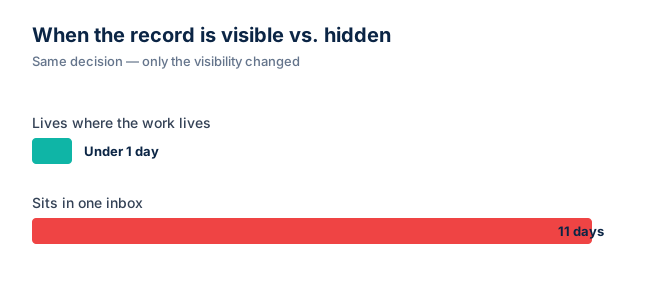
What this looks like on a real project
Picture a mid-sized capital program a year into delivery. Three contractors are on site, two engineering firms are still issuing revisions, and a funder has just asked for a status update before the next disbursement. The work itself is going well. The proof of how it has been going is scattered across three inboxes, two shared drives, and a paper file in the project trailer.
Nothing about that scene is unusual. It is, in fact, the default state of most capital projects that have grown faster than their record-keeping. The team is not careless. They are simply doing what works in the moment — sending an email, saving a PDF, marking up a drawing — without a clean way to make the moment count later.
The cost shows up at the worst possible time: during an audit, a dispute, or a leadership change. Someone asks a precise question, and the answer requires reconstructing a conversation that happened six months ago between two people, only one of whom is still on the team.
A funder request that used to take a week of stitching together now takes an afternoon
A new team member can see what was decided and why, without asking three people
A dispute moves from memory and tone to the record and the timeline
A leadership change does not reset the project's institutional knowledge to zero
Funded is not the same as finished
These are the records that turn a hard question into a two-minute answer:
Procurement justification. Why this vendor, this price, this process — documented at the time, not rationalized after.
The decision record. Who approved what, when, and on what basis — captured as it happened, not reconstructed under pressure.
The contract and its change orders. The original plus every amendment, in order, with nothing living only in an email thread.
Meeting minutes and direction. Especially anything that changed scope, schedule, or budget.
Closeout and retention. What was delivered, who signed for it, and proof you kept what you must keep.
The fix isn't 'try harder.' It's to stop keeping the record separate from the work, so the proof accumulates on its own.
XNM-VISION closes that gap for audit teams. Every decision, document, and dollar lives in one place, captured as the work happens, so 'audit-ready' is your resting state rather than a sprint.
And it scales with the work, not the headcount: from a single capital projects to a whole portfolio, the record stays consistent, current, and provable on demand.
The money will keep flowing toward big builds. The teams that win the next decade won't be the ones who got funded — they'll be the ones who could prove, on any given Tuesday, exactly how the work was run.
How XNM-VISION changes the working day
The shift XNM-VISION makes is small but compounding. Instead of a folder where documents land and an inbox where decisions live, the record and the work share a single object. Approving a change order, attaching a revised drawing, and noting the reason all happen in the same place — and they stay together.
That removes a class of work that nobody enjoyed anyway: the weekly reconciliation between what is actually happening and what the file shows. When the file is the work, reconciliation is not a task. It is a property of the system.
What teams notice first is that meetings get shorter. The opening ten minutes that used to be spent agreeing on what version of reality everyone is looking at simply disappear. The dashboard is the version of reality. Disagreements move to the decision itself, where they belong.
Practical steps to take this quarter
None of this requires a rebuild. The teams that get the most out of a single source of truth tend to do the same handful of things in their first ninety days:
Pick one program to start with. Do not try to migrate everything at once. Choose the project where the cost of disorder is highest and the team is most willing to change one habit.
Move the live record into the system first. Approvals, decisions, current versions, and the schedule. The archive can follow. Today's work is what changes the outcome.
Name an owner for every record class. Contracts, change orders, invoices, drawings, minutes. One name per class, with a clear backup, removes ninety percent of the orphan documents.
Set a weekly five-minute review. Not a meeting — a glance at what is missing, what is overdue, and what is sitting in one person's inbox. The discipline is small. The compounding is large.
The reason this matters is not abstract. Capital projects live and die on the ability to defend a sequence of decisions against people who were not in the room when the decisions were made. The teams that can do that — calmly, on demand — keep their funding, their reputation, and their schedule.
The teams that cannot do that spend their energy re-litigating the past instead of building the next thing. Over a multi-year program, that energy adds up to entire quarters of lost momentum.
We take apart a failure like this every week. Closing exactly this gap is why we built XNM-VISION.