Straight Answers for Provincial agencies on the Audit Question

Through 2024, provincial agencies watched the 2024 fall fiscal update move money and attention toward big builds. The capital is the easy part. The hard part shows up later, in whether you can prove what you decided and when.
The quiet truth is that most overruns aren't decisions gone wrong. They're decisions that went fine but couldn't be proven, defended, or found in time.
The records that settle questions
provincial agencies rarely fail for lack of effort. They fail because the proof is scattered — a sign-off here, an invoice there, a change order in a thread no one can find under pressure.
It compounds over time. Every handoff between provincial agencies and their partners is a chance for a version to fork, an approval to go unrecorded, or a commitment to survive only in someone's memory.
Step back and the pattern is almost mechanical. Money arrives, ambition rises, the project grows — and the volume of decisions grows with it, faster than any inbox or folder can keep straight. For provincial agencies, the failure is rarely dramatic; it is a slow accumulation of small, unrecorded moments that only add up to a problem when someone with authority starts asking questions. The 2024 fall fiscal update is making that someone show up sooner, and more often. The teams that feel calm about it are not working harder — they simply never let the record and the work drift apart in the first place.
In practice, the gaps cluster in a few familiar places:
A funder's reporting requirement nobody mapped to a document
An approval that exists but isn't visible to the work
A commitment made in a meeting and never written down
The one attachment that proves the whole timeline
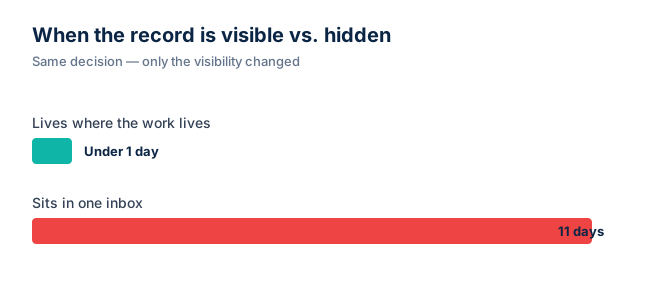
The decision wasn't wrong — it was invisible
If you keep nothing else in a single system, keep these:
The contract and its change orders. The original plus every amendment, in order, with nothing living only in an email thread.
Closeout and retention. What was delivered, who signed for it, and proof you kept what you must keep.
Version history. Proof of which drawing, spec, or policy was current on any given day.
The decision record. Who approved what, when, and on what basis — captured as it happened, not reconstructed under pressure.
Meeting minutes and direction. Especially anything that changed scope, schedule, or budget.
The way out is not more effort. It's a single place where the decision, the document, and the work are the same object.
the XNM-VISION records engine closes that gap for provincial agencies. Every decision, document, and dollar lives in one place, captured as the work happens, so 'audit-ready' is your resting state rather than a sprint.
Teams stand it up fast: the XNM-VISION records engine deploys in days, not the months a traditional system takes, and it carries unlimited users, so every partner, reviewer, and field lead works from the same picture.
Being delivery-ready early — with the record built in from day one — is the quiet advantage. It doesn't make headlines, but it's the difference between a project that finishes and one that stalls.
What this looks like in practice
Picture a Tuesday afternoon on a live project. A funder’s analyst emails one of your provincial agencies, asking for the approval that authorized a specific change order, plus the invoice paid against it, and the procurement justification for the vendor. None of those three documents are missing. They simply live in three different places, owned by three different people, with two of them on leave that week.
In the calm version of this story, the project lead opens one record, sees the gate that was passed, the contract amendment that flowed from it, the invoice tied back to that amendment, and the procurement memo written at the time. The whole reply takes nine minutes. The analyst goes away. The project keeps moving.
In the frantic version, the same evidence exists somewhere in the organization. But assembling it takes four people, two days, and a series of awkward emails to vendors and former staff. The cost is rarely the missing paper. It is the trust that erodes while provincial agencies reconstruct what they already had.
Most teams sit somewhere between those two versions. The point is not to be perfect. The point is to shrink the gap between doing the work and recording it, so the calm version is closer to your average day than the frantic one.
A short, practical sequence
If you do nothing else this quarter, work through this short list in order. Each step takes hours, not weeks, and each one removes a specific class of audit risk.
Pick one project and walk a single dollar. From budget line, to approval, to contract clause, to invoice paid, to bank record. Note every place the trail breaks.
Move the decision record off email. Approvals belong in the project record with a name and a timestamp, not buried in a thread that only three people can search.
Tie every invoice to a commitment. If a payment cannot be traced to the contract or change order that authorized it, that is the next thing to fix — before the next audit, not during one.
Make the current drawing obvious. One version, one location, one stamp. Field crews should never have to guess which file is live.
These four moves cost almost nothing. They quietly close most of the gaps that turn into findings later. They also give provincial agencies a way to demonstrate, on demand, that the organization knows what it spent, why it spent it, and who signed off.
XNM-VISION is built to make this the default for provincial agencies. The records engine sits behind the work you already do, captures the trail as it happens, and gives a project lead one place to answer the question every funder eventually asks: prove it.
None of this is dramatic. That is precisely the point. The teams who weather scrutiny best are not the ones who scramble well. They are the ones who never have to scramble in the first place.
This is the gap XNM closes for capital teams. Learn how in our overview of XNM-VISION.