Straight Answers for Non-profits on the Audit Question

Every non-profits we talk to has the same 2023 story. the widening municipal infrastructure deficit raised the stakes, the project got bigger, and the paperwork that proves it got harder to keep straight.
The quiet truth is that most overruns aren't decisions gone wrong. They're decisions that went fine but couldn't be proven, defended, or found in time.
What the widening municipal infrastructure deficit actually changes
Most non-profits are managing grant-funded work and reporting deadlines across email, spreadsheets, and three or four tools that don't talk to each other. The information exists. It just can't be assembled when it counts.
It compounds over time. Every handoff between non-profits and their partners is a chance for a version to fork, an approval to go unrecorded, or a commitment to survive only in someone's memory.
Consider how this plays out for non-profits in practice. A decision gets made in a meeting, refined over a few emails, approved with a nod, and then executed by a crew who never saw any of it written down. Months later — often once the widening municipal infrastructure deficit has put every project under a brighter light — someone asks a question that should be easy: show me where this was approved, and by whom. The work itself was sound. The trail behind it was not. And it is precisely in that gap, between a good decision and a provable one, that budgets quietly disappear and schedules slip.
The usual suspects, every time:
The current drawing, versus three that look almost identical
The signed copy, versus the draft everyone kept editing
The retention proof that you kept what you must keep
The single thread that explains why a number changed
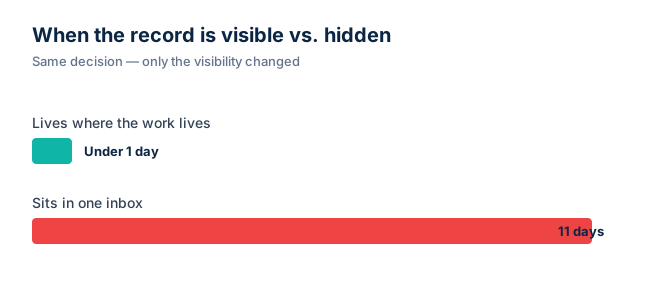
The decision wasn't wrong — it was invisible
The short list of what should never be left scattered:
Version history. Proof of which drawing, spec, or policy was current on any given day.
Closeout and retention. What was delivered, who signed for it, and proof you kept what you must keep.
Approvals and sign-offs. Every gate with a name and date attached, visible to everyone the decision touches.
Invoices matched to the contract. Each dollar paid, tied to the commitment that authorized it.
Procurement justification. Why this vendor, this price, this process — documented at the time, not rationalized after.
The way out is not more effort. It's a single place where the decision, the document, and the work are the same object.
one auditable system closes that gap for non-profits. Every decision, document, and dollar lives in one place, captured as the work happens, so 'audit-ready' is your resting state rather than a sprint.
The payoff for non-profits is calm. When a question comes, the answer is already assembled — approval, version, and justification side by side — so a review becomes a search, not a scramble.
Being delivery-ready early — with the record built in from day one — is the quiet advantage. It doesn't make headlines, but it's the difference between a project that finishes and one that stalls.
What gets lost between systems
The damage is rarely a single dramatic failure. It is the steady accumulation of small gaps: the spec attached to one email but not the project folder, the change order discussed on a call but never written up, the contract amendment signed but never linked to the invoices it controls. None of these feels urgent in the moment. Together, by year three of a multi-year build, they form a fog that no spreadsheet can burn off.
The teams who escape this pattern have one thing in common. They stopped treating the record as something to be assembled later, and started treating it as the natural by-product of getting the work done. The difference shows up the first time a funder asks a hard question and the answer arrives in minutes, not days.
A single intake address that turns every inbound email into a filed record automatically
Versioned drawings and specs so the current set is never in doubt
Approvals captured as structured events with a name, a timestamp and a basis
Invoices linked to the contract clause that authorized the spend
A closeout package that builds itself as gates are passed, not at the end
A small scene from a typical week
Picture a regional team mid-build. A reviewer flags a concern about a substitution that was made eight months earlier. In the old world, that question triggers a week of archaeology: who signed off, against which drawing, on what basis. In the new world, the answer is one click: the approval, the superseded spec, the email thread, the affected invoices, all on one page, in order, with names and dates.
That is not a productivity gain. It is a different posture in front of every funder, auditor and board. It is the difference between being on defence and being able to lead the conversation.
Pick one project to stand up first. Not the biggest or the messiest, but the one whose record you are most likely to be asked about in the next six months.
Point the intake address at the people already doing the work. Forward in, file once, no second job.
Set the gates that matter. Approvals, change orders, invoice match. Skip ceremony, keep proof.
Rehearse the audit answer. Pick five likely questions and time how long it takes to answer them today. Measure again in 30 days.
Why this matters now
Capital dollars are moving faster than they ever have, and the cost of slow proof is climbing with them. Programs are being layered: federal, provincial, own-source, partner contributions, each with its own reporting rhythm. The team that can answer cleanly across all of them earns the next round. The team that cannot is told, politely, to come back when things are tidier.
XNM-VISION is built for this moment. It does not ask anyone to change how they work day-to-day. It quietly captures the record as work happens, and gives every authorized person the same picture, in the same place, at the same time.
XNM has helped public-sector and capital teams make audit-ready their normal state since 2013. See how XNM-VISION works.