Straight Answers for Forestry operators on the Audit Question

Every forestry operators we talk to has the same 2023 story. Canada's Critical Minerals Strategy raised the stakes, the project got bigger, and the paperwork that proves it got harder to keep straight.
This matters because the cost of a lost record is rarely the record. It's the six weeks, the redone work, and the credibility you spend reconstructing something you already had.
That trust, once shaken, is expensive to rebuild. It tends to come back not through a single dramatic gesture but through dozens of small, traceable answers delivered on demand. The teams that handle scrutiny well are not the ones with the thickest binders; they are the ones whose binders no longer matter, because the proof is already living inside the work.
The records that settle questions
Most forestry operators are managing tenure, stewardship records, and field compliance across email, spreadsheets, and three or four tools that don't talk to each other. The information exists. It just can't be assembled when it counts.
Look closer at any forestry operators and the same fault line appears: the people doing the work and the people who must answer for it are reading from different copies. One has the latest drawing; the other has last month's.
It helps to name the real adversary, because it is not incompetence. For forestry operators, the adversary is entropy — the natural tendency of a busy project to scatter its own evidence across people, tools, and time until no single place holds the whole truth. Every reorganization, every staff change, every 'we'll clean it up later' feeds it. Canada's Critical Minerals Strategy did not create this problem, but it raised the cost of it, because more scrutiny means more moments when scattered evidence has to be pulled back together at speed. Structure is the only thing that reliably beats entropy.
These are the records that go missing first:
A funder's reporting requirement nobody mapped to a document
An approval that exists but isn't visible to the work
A commitment made in a meeting and never written down
The one attachment that proves the whole timeline
How invisibility happens in practice
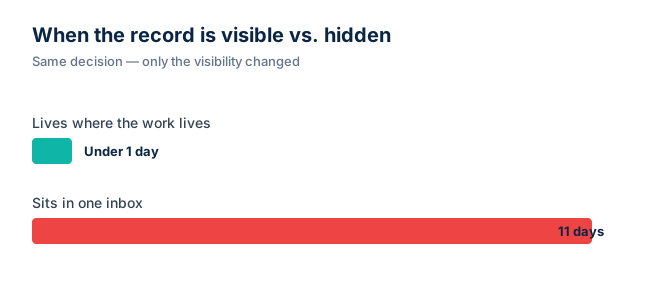
None of this comes from carelessness. A typical sequence looks like this: a program lead raises a concern in a Tuesday meeting; the project manager agrees by email Wednesday; a designer or specialist issues a revised document Thursday; a director gives a verbal nod Friday. By the following Monday the change is being executed — and the only person who can prove it was approved is on vacation. Each step was correct in isolation. The system that should have stitched them together did not exist.
Multiply that pattern across a portfolio of sites, upgrades, and emergency works, and the resulting drift is not a few missing files. It is the slow, invisible erosion of the connection between the project on the ground and the project on the page.
The records that settle questions
These are the records that turn a hard question into a two-minute answer:
Meeting minutes and direction. Especially anything that changed scope, schedule, or budget.
The contract and its change orders. The original plus every amendment, in order, with nothing living only in an email thread.
Invoices matched to the contract. Each dollar paid, tied to the commitment that authorized it.
The decision record. Who approved what, when, and on what basis — captured as it happened, not reconstructed under pressure.
Approvals and sign-offs. Every gate with a name and date attached, visible to everyone the decision touches.
What audit-ready actually looks like day to day
Audit-ready is less a state and more a habit baked into ordinary work. It looks like a project manager who never has to forward an old email because the approval is already attached to the record. It looks like a finance officer who can match an invoice to a change order in seconds, not days. It looks like a senior leader who can open a single view and see, project by project, where the money has gone and what remains.
A current version of every key document, with prior versions one click away
A visible owner for every open decision, with the date it became open
A trail of approvals that reads top-to-bottom without needing translation
A finance view that ties each commitment to the dollar that funded it
Practical first steps for a forestry team that wants to make this real:
Pick one program. Start where the scrutiny is highest — a major build or a funded expansion — and make that the proof point.
Map who needs to see what. Operations, finance, partners, governance. Visibility is the cheap fix that solves the most expensive problems.
Move approvals into the open. If an approval can only be found in an inbox, it functionally does not exist.
Let the record build itself. Wire the system to your existing email and folders so the proof lands where the work lives, automatically.
What changes the outcome isn't heroics at audit time. It's removing the gap between doing the work and recording it.
one auditable system closes that gap for forestry operators. Every decision, document, and dollar lives in one place, captured as the work happens, so 'audit-ready' is your resting state rather than a sprint.
Crucially, one auditable system doesn't ask forestry operators to change how they work. It sits on top of the sources you already have, turning scattered effort into one auditable trail without a migration project.
Being delivery-ready early — with the record built in from day one — is the quiet advantage. It doesn't make headlines, but it's the difference between a project that finishes and one that stalls.
Want to see what one source of truth looks like for your projects? Talk to us — it's a short conversation.