Straight Answers for Forestry operators on the Audit Question
Through 2023, forestry operators watched the record 2023 wildfire season move money and attention toward big builds. The capital is the easy part. The hard part shows up later, in whether you can prove what you decided and when.
The quiet truth is that most overruns aren't decisions gone wrong. They're decisions that went fine but couldn't be proven, defended, or found in time.
The records that settle questions
Most forestry operators are managing tenure, stewardship records, and field compliance across email, spreadsheets, and three or four tools that don't talk to each other. The information exists. It just can't be assembled when it counts.
It compounds over time. Every handoff between forestry operators and their partners is a chance for a version to fork, an approval to go unrecorded, or a commitment to survive only in someone's memory.
It helps to name the real adversary, because it is not incompetence. For forestry operators, the adversary is entropy — the natural tendency of a busy project to scatter its own evidence across people, tools, and time until no single place holds the whole truth. Every reorganization, every staff change, every 'we'll clean it up later' feeds it. the record 2023 wildfire season did not create this problem, but it raised the cost of it, because more scrutiny means more moments when scattered evidence has to be pulled back together at speed. Structure is the only thing that reliably beats entropy.
When a project gets questioned, these are the items everyone scrambles for:
The current drawing, versus three that look almost identical
The signed copy, versus the draft everyone kept editing
The retention proof that you kept what you must keep
The single thread that explains why a number changed
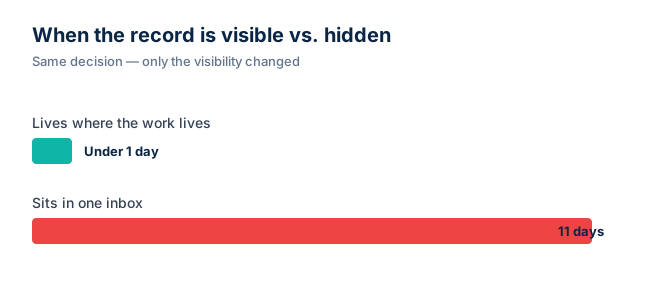
The decision wasn't wrong — it was invisible
The short list of what should never be left scattered:
Closeout and retention. What was delivered, who signed for it, and proof you kept what you must keep.
Version history. Proof of which drawing, spec, or policy was current on any given day.
Meeting minutes and direction. Especially anything that changed scope, schedule, or budget.
Invoices matched to the contract. Each dollar paid, tied to the commitment that authorized it.
Approvals and sign-offs. Every gate with a name and date attached, visible to everyone the decision touches.
What changes the outcome isn't heroics at audit time. It's removing the gap between doing the work and recording it.
That is exactly what the XNM-VISION records engine is built to do. It keeps capital projects and the records that prove them in one auditable system — approvals, versions, contracts, and change orders, each with a name and a date attached.
Crucially, the XNM-VISION records engine doesn't ask forestry operators to change how they work. It sits on top of the sources you already have, turning scattered effort into one auditable trail without a migration project.
Funding gets you to the starting line. Records are what carry you across it. In a year defined by the record 2023 wildfire season, that distinction is the whole game.
What the gap looks like in practice
Imagine a mid-sized capital project in its second year: a new community building, a road rebuild, or a housing block. The original scope has shifted twice, the prime contractor has issued three change orders, and the funder has asked for a quarterly progress note. Nothing on that list is unusual; what makes it painful is that the answers live in five inboxes, two shared drives, a stack of printed binders, and one person's memory.
When a question lands, somebody has to choose between giving a fast answer that may be wrong and a slow answer that is correct but late. Both choices erode trust. Over a long enough timeline, that erosion becomes the project's real cost — not the line item that overran, but the credibility that quietly drained away while everyone was busy.
A decision was made in a meeting but never written down in a place anyone can find later
Two versions of the same drawing are in circulation and nobody is sure which one the crew is building from
An invoice arrives that no one can match to a signed contract or change order
A funder asks for a report and the team rebuilds it from scratch instead of exporting it
How XNM-VISION closes the loop
XNM-VISION does not ask teams to work harder; it asks the system to remember more. Every approval, version, dollar, and document is stamped with a name and a date as the work happens, then linked to the project, the contract, and the decision it belongs to. The record is a by-product of the work, not a second job bolted on after the fact.
The practical effect is quiet but compounding. The weekly status meeting gets shorter because the status is already visible. The audit response gets faster because the evidence is already assembled. The funder relationship gets calmer because the next question is answered before it is asked.
Make the record the work. Capture approvals, invoices, and versions in the same place the team already operates — not in a parallel filing exercise.
Link everything to a project. A document with no project is a document that will be lost; a document tied to a project is a document that explains itself a year later.
Show the trail. Every change should carry a name, a date, and a reason, visible to anyone the work touches without a special request.
Export, don't rebuild. When a funder or auditor asks, the answer should be a download, not a project.
None of this requires a heroic change-management campaign. It requires a default that favours the next person who has to answer a question about this project — which is, more often than not, a future version of the team itself.
Want to see what one source of truth looks like for your projects? Talk to us — it's a short conversation.