One Source of Truth: The Case for Provincial agencies in 2026

When the shift from approving major projects to delivering them dominated the headlines in 2026, provincial agencies felt the pressure shift. The era of arguing for funding is giving way to a harder era of accounting for it.
What's really at risk isn't tidiness. It's whether a funder, an auditor, or a partner can look at your project and trust that it was run the way you say it was.
The records that settle questions
For provincial agencies, the trouble starts when the record of the work and the work itself drift apart. Approvals live in inboxes, contracts live on someone's drive, and the field never sees either.
Look closer at any provincial agencies and the same fault line appears: the people doing the work and the people who must answer for it are reading from different copies. One has the latest drawing; the other has last month's.
It helps to name the real adversary, because it is not incompetence. For provincial agencies, the adversary is entropy — the natural tendency of a busy project to scatter its own evidence across people, tools, and time until no single place holds the whole truth. Every reorganization, every staff change, every 'we'll clean it up later' feeds it. the shift from approving major projects to delivering them did not create this problem, but it raised the cost of it, because more scrutiny means more moments when scattered evidence has to be pulled back together at speed. Structure is the only thing that reliably beats entropy.
When a project gets questioned, these are the items everyone scrambles for:
Which version of the budget is the real one
Whether a scope change was ever formally approved
The minutes where direction actually changed
Closeout proof of what was delivered and who signed for it
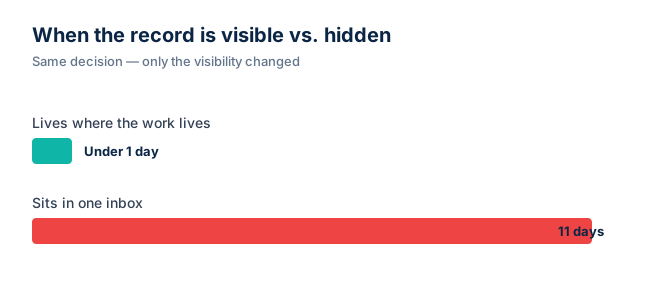
The records that settle questions
If you keep nothing else in a single system, keep these:
Procurement justification. Why this vendor, this price, this process — documented at the time, not rationalized after.
Invoices matched to the contract. Each dollar paid, tied to the commitment that authorized it.
The decision record. Who approved what, when, and on what basis — captured as it happened, not reconstructed under pressure.
Approvals and sign-offs. Every gate with a name and date attached, visible to everyone the decision touches.
Version history. Proof of which drawing, spec, or policy was current on any given day.
You don't solve this with another reminder or another folder. You solve it by making the record a by-product of doing the work, not a second job.
This is the problem XNM-VISION was designed around: one source of truth for multi-year capital plans across many sites, ingesting from the inboxes and folders you already use, so nothing has to be reassembled later.
And it scales with the work, not the headcount: from a single capital projects to a whole portfolio, the record stays consistent, current, and provable on demand.
The money will keep flowing toward big builds. The teams that win the next decade won't be the ones who got funded — they'll be the ones who could prove, on any given Tuesday, exactly how the work was run.
What changes in practice
On a typical capital project, the friction is rarely with any single decision. It is the trail behind the decision — the email that referenced the spec, the version everyone signed, the budget line that moved on Tuesday and again on Thursday. When that trail is scattered across drives, inboxes, and a few well-meaning spreadsheets, even a well-run team spends days every month reconstructing what already happened.
The shift is quieter than people expect. Nobody asks for new heroics. They ask, instead, for the next request to feel routine: open the project, see the approvals, see the invoices that point at the approvals, see the version of the drawing that was current the day the change was made. That is the practical bar.
Every approval shows the person, the date, and the document version it acted on
Every invoice is tied to a purchase order, a budget line, and a deliverable
Every contract change links to the contract it amends and the cost impact it creates
Every record has a clear retention period, with deletions logged rather than silent
A practical sequence that works
Teams that move from scattered records to a single trail tend to follow the same short path. It is not glamorous, but it ends the recurring fire drills and gives leadership a defensible answer when a board or funder asks the obvious question.
Inventory the questions you keep getting asked. Funder reports, board updates, audit trails, FOI-style requests — list the ten questions that come back monthly, and trace where each answer currently lives.
Pick one project to make whole. Move its approvals, contracts, invoices, change orders, and current drawings into one workspace, with retention rules on day one.
Wire the rest to that workspace. Replace ad-hoc email handoffs with structured requests, so the record is created as a by-product of the work, not after the fact.
Make the proof routine. Turn the ten recurring questions into saved views any authorised user can open without asking.
The compounding effect is hard to see in week one and impossible to miss in month six. Reports take a fraction of the time, audits stop dragging on schedule, and the team begins to make decisions from a shared picture instead of competing screenshots.
How XNM-VISION fits in
XNM-VISION is built around exactly this shape of work: a records engine for capital projects, configured so the trail is created as the work happens. Approvals, invoices, change orders, drawings, and the conversations that surround them sit beside the project they belong to, with retention rules and access tiers set once and enforced quietly forever after.
The teams we work with do not describe it as a software change. They describe it as a quieter month: fewer hunts, fewer reconstructions, fewer surprises when somebody asks for the file that proves the decision. That is the version of modern capital delivery worth aiming for.
If your last review felt like a fire drill, that's a records problem, not a character flaw — and a solvable one. See how teams make ready their resting state with XNM-VISION.