One Source of Truth: The Case for Project teams in 2025

Ask anyone running permits, drawings, contracts, and change orders what kept them up in 2025, and fresh reporting on the national infrastructure deficit is only half the answer. The other half is quieter: the fear of not being able to find the one record that settles a question.
And the bill always comes due at the worst moment: mid-build, mid-audit, or mid-dispute, when the missing piece is suddenly the only piece that matters.
Where the proof goes to hide
Most project teams are managing permits, drawings, contracts, and change orders across email, spreadsheets, and three or four tools that don't talk to each other. The information exists. It just can't be assembled when it counts.
And it bites hardest exactly when it matters most. The day a funder calls, the week an audit lands, the moment a dispute starts — that is when project teams learn which records they can actually produce and which they only thought they had.
There is a reason this keeps happening even to careful project teams. The tools that hold the work — email, shared drives, spreadsheets, a project app or two — were each built to do one job well, not to keep a single, time-stamped record of what was decided and why. So the record becomes a manual chore bolted onto the real work, and it is the first thing to slip when permits, drawings, contracts, and change orders gets busy. In a year shaped by fresh reporting on the national infrastructure deficit, that one dropped chore is exactly what returns, months later, as a finding, a dispute, or a number nobody can explain.
Here is where the proof tends to hide:
Which version of the budget is the real one
Whether a scope change was ever formally approved
The minutes where direction actually changed
Closeout proof of what was delivered and who signed for it
The records that settle questions
Put plainly, an audit-ready project keeps these together from day one:
The decision record. Who approved what, when, and on what basis — captured as it happened, not reconstructed under pressure.
Approvals and sign-offs. Every gate with a name and date attached, visible to everyone the decision touches.
Closeout and retention. What was delivered, who signed for it, and proof you kept what you must keep.
Meeting minutes and direction. Especially anything that changed scope, schedule, or budget.
Version history. Proof of which drawing, spec, or policy was current on any given day.
The way out is not more effort. It's a single place where the decision, the document, and the work are the same object.
That is exactly what XNM-VISION is built to do. It keeps capital projects and the records that prove them in one auditable system — approvals, versions, contracts, and change orders, each with a name and a date attached.
Teams stand it up fast: XNM-VISION deploys in days, not the months a traditional system takes, and it carries unlimited users, so every partner, reviewer, and field lead works from the same picture.
Being delivery-ready early — with the record built in from day one — is the quiet advantage. It doesn't make headlines, but it's the difference between a project that finishes and one that stalls.
What this looks like in practice
Picture a typical month for project teams. A scope item moves from a planning conversation to a draft, then to a vendor quote, then to an approval, then to a purchase order, then to an invoice. Each step generates a record. Each record has a sender, a recipient, a date, and a reason. When all of those records sit in one place, the work tells its own story. When they don't, every story has to be reconstructed by hand, usually under pressure, and usually by the one person who happens to remember what was said in a meeting eight months ago.
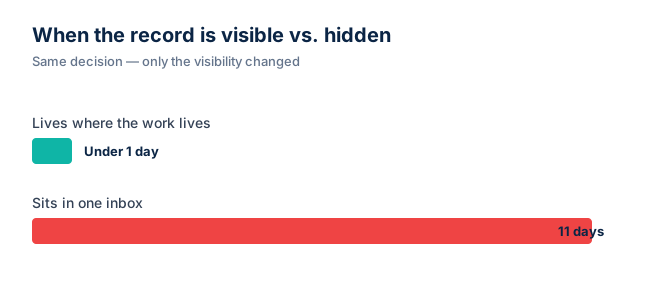
The pattern repeats across portfolios. A reviewer asks a single, fair question — when was this approved, against which version of the spec, with what budget remaining? The team that can answer in minutes is not working harder than the team that takes a week. They are working from a different shelf. One shelf is sorted, dated, and named. The other is a pile that nobody quite owns, scattered across an inbox, a shared drive, a chat thread, and a personal folder on a laptop that may or may not be backed up.
There is a quieter cost too. Time spent searching for a record is time not spent on the next decision. A senior person hunting through email for a signed scope change is a senior person not advancing the file. Over a year, those hours add up to a real number, and that number is paid for by either the schedule or the budget. Usually both.
A small example that scales
Consider a single change order on a single line item: a switch from one material to another, approved verbally on a Tuesday, confirmed by email on a Thursday, paid the following month. By itself the change is small. Multiply it by a portfolio of project teams handling dozens of files a year, and the same small gap becomes the source of most overruns and most uncomfortable audits. The fix is not heroism. It is putting that single decision somewhere the next reader can find it without asking three people.
The same logic applies to a meeting decision, a phone call with a contractor, a quick text approving an additional site visit. None of them feels record-worthy in the moment. All of them are exactly the records that will be asked for later. The discipline is not to write more. The discipline is to put what already gets written in one findable place.
Practical steps to close the gap
Name one owner for the record, not the task. The work can be shared. The record cannot be ambiguous about who is responsible for keeping it whole.
Make the trail visible by default. If a reviewer cannot see the approval without being granted access, the approval is effectively missing.
Capture decisions where they happen. A short note attached to the file beats a long note in someone's inbox every time.
Tie money to commitments. Every invoice should point back to the contract or purchase order that authorized it, with no human translation step in between.
Set a clock everyone can see. If a deadline only lives in one person's calendar, the team has no shared sense of urgency until it is too late to act.
The hidden value of being audit-ready every day
Audit-ready is not a state you reach by working harder in the two weeks before a review. It is a state you reach by changing where records live, once. After that, every file is already in shape, because the working copy and the record copy are the same copy. The team is not preparing for an audit. The team is just doing the work, and the audit happens to be possible at any moment.
That shift unlocks a second benefit that does not show up on any invoice. New people join the team and become productive in days, not months, because the trail is the training. They can read the last six decisions and understand the file. Knowledge stops being something a few veterans carry in their heads. It becomes something the system itself remembers.
Why this matters now
Public attention on capital spending is not going away. Funders, boards, and reviewers are asking sharper questions and expecting faster answers. For project teams, the cost of a slow answer has gone up. The cost of a fast, complete one has come down, because the tools to produce it now exist and do not require a migration project to put in place. Teams that get ahead of this shift spend less time on defence and more time on the work that brought them to the file in the first place.
None of this requires changing how the work gets done. It only requires changing where the proof of the work lives. That single shift, made once, pays back across every file a project team touches for the rest of the year, and quietly removes a category of risk that most teams have simply learned to live with.
XNM has helped public-sector and capital teams make audit-ready their normal state since 2013. See how XNM-VISION works.