One Source of Truth: The Case for Northern infrastructure teams in 2023
Every northern infrastructure team we talk to has the same 2023 story. Canada's Critical Minerals Strategy raised the stakes, the project got bigger, and the paperwork that proves it got harder to keep straight.
This matters because the cost of a lost record is rarely the record. It's the six weeks, the redone work, and the credibility you spend reconstructing something you already had.
What Canada's Critical Minerals Strategy actually changes
Most northern infrastructure teams are managing remote builds with short seasons and long supply lines across email, spreadsheets, and three or four tools that don't talk to each other. The information exists. It just can't be assembled when it counts.
The cost isn't only the missing document. It's the meeting to look for it, the second meeting to recreate it, and the slow erosion of trust every time someone has to say 'let me get back to you on that.'
How the gap actually forms
The gap rarely opens in a single dramatic moment. It opens quietly, across dozens of small handoffs: a scope note discussed in a call but never written down, an approval given verbally because the meeting was running late, a vendor change communicated by email but never reflected in the contract file. Each handoff is reasonable on its own. Together they create a paper trail that does not match the work.
In practice, the team running the project usually knows what happened. The trouble is that the next reviewer — an auditor, a funder, a board member, sometimes a court — does not. They cannot interview ten people. They read the file. If the file does not stand on its own, the answer is treated as unproven, even when it is correct.
A scope change agreed in a meeting but never reflected in the contract amendment.
An invoice approved on trust, with no matching delivery note or progress report.
A risk identified by a site supervisor that never reached the steering committee minutes.
A funder condition that was met but cannot be evidenced because the supporting document was filed under a different project name.
Consider how this plays out for northern infrastructure teams in practice. A decision gets made in a meeting, refined over a few emails, approved with a nod, and then executed by a crew who never saw any of it written down. Months later — often once Canada's Critical Minerals Strategy has put every project under a brighter light — someone asks a question that should be easy: show me where this was approved, and by whom. The work itself was sound. The trail behind it was not. And it is precisely in that gap, between a good decision and a provable one, that budgets quietly disappear and schedules slip.
These are the records that go missing first:
Which version of the budget is the real one
Whether a scope change was ever formally approved
The minutes where direction actually changed
Closeout proof of what was delivered and who signed for it
The records that settle questions
Here is what belongs in one place, with a name and a date on every item:
The contract and its change orders. The original plus every amendment, in order, with nothing living only in an email thread.
Version history. Proof of which drawing, spec, or policy was current on any given day.
Procurement justification. Why this vendor, this price, this process — documented at the time, not rationalized after.
Meeting minutes and direction. Especially anything that changed scope, schedule, or budget.
Invoices matched to the contract. Each dollar paid, tied to the commitment that authorized it.
What changes the outcome isn't heroics at audit time. It's removing the gap between doing the work and recording it.
This is the problem one auditable system was designed around: one source of truth for remote builds with short seasons and long supply lines, ingesting from the inboxes and folders you already use, so nothing has to be reassembled later.
And it scales with the work, not the headcount: from a single capital project to a whole portfolio, the record stays consistent, current, and provable on demand.
The money will keep flowing toward big builds. The teams that win the next decade won't be the ones who got funded — they'll be the ones who could prove, on any given Tuesday, exactly how the work was run.
A practical sequence that works
Teams that consistently pass scrutiny tend to follow a short, repeatable sequence. It is not glamorous, and it does not require new headcount. It requires that the record is built as the work is done, not reconstructed afterwards.
Capture the decision the day it is made. One short note: what was decided, who decided, what it changes, what it costs, and which document or contract it touches.
Attach the evidence to the decision. The quote, the drawing, the email, the risk note — linked directly to the decision so the chain is visible at a glance.
Reconcile money against the contract every month. Invoiced-to-date, committed, remaining — not in a separate spreadsheet, but against the contract itself.
Close the loop with the funder or board in writing. A short status update referencing the decisions and the spend, so the external record matches the internal one.
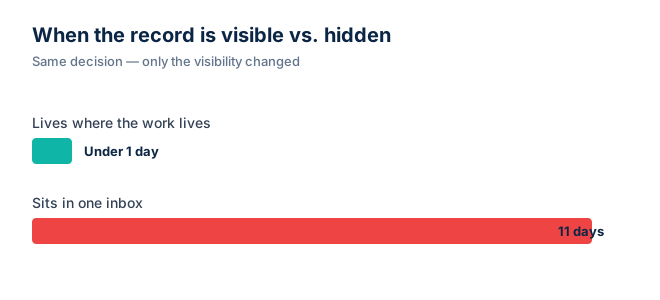
None of these steps are new. What changes is where they live. When they live in one place, tied to the project and the contract, the question "can you prove it?" becomes a two-minute query instead of a two-week scramble.
XNM has helped public-sector and capital teams make audit-ready their normal state since 2013. See how XNM-VISION works.