One Source of Truth: The Case for Mine operators in 2023
Ask anyone running permitting, community agreements, and closure obligations what kept them up in 2023, and Canada's Critical Minerals Strategy is only half the answer. The other half is quieter: the fear of not being able to find the one record that settles a question.
And the bill always comes due at the worst moment: mid-build, mid-audit, or mid-dispute, when the missing piece is suddenly the only piece that matters.
The decision wasn't wrong — it was invisible
For mine operators, the trouble starts when the record of the work and the work itself drift apart. Approvals live in inboxes, contracts live on someone's drive, and the field never sees either.
The cost of the gap, in plain numbers
The cost of a records gap rarely shows up as a single budget line. It shows up as a week lost reconciling a draw package, a crew sitting because a drawing version was unclear, a funder pausing a disbursement while someone hunts for an approval email. None of these are catastrophes alone. Stacked across a year, they are the difference between a project that finishes on plan and one that quietly slips by a quarter.
Where the hours actually go
Re-reading email threads to confirm a decision made weeks ago
Comparing two drawings to figure out which is current
Re-creating a meeting note because the original is on someone's laptop
Chasing a signature that was sent, signed, and then misfiled
Reassembling a chain of change orders to answer one funder question
It compounds over time. Every handoff between mine operators and their partners is a chance for a version to fork, an approval to go unrecorded, or a commitment to survive only in someone's memory.
Consider how this plays out for mine operators in practice. A decision gets made in a meeting, refined over a few emails, approved with a nod, and then executed by a crew who never saw any of it written down. Months later — often once Canada's Critical Minerals Strategy has put every project under a brighter light — someone asks a question that should be easy: show me where this was approved, and by whom. The work itself was sound. The trail behind it was not. And it is precisely in that gap, between a good decision and a provable one, that budgets quietly disappear and schedules slip.
In practice, the gaps cluster in a few familiar places:
Which version of the budget is the real one
Whether a scope change was ever formally approved
The minutes where direction actually changed
Closeout proof of what was delivered and who signed for it
Funded is not the same as finished
A generic scenario, played out two ways
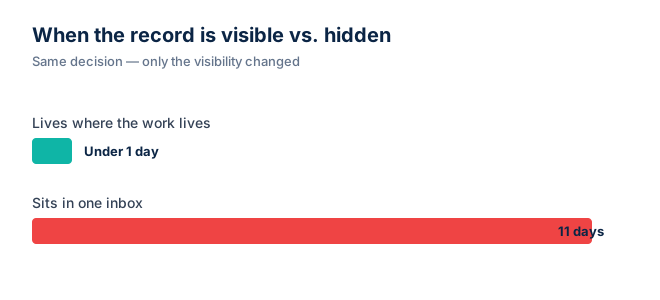
Picture a mid-sized capital project — a community facility, a depot, a water upgrade; the specifics don't matter. Halfway through construction, a regulator asks a routine question about a design change. In the first version, the team spends three days pulling the answer from four systems and two inboxes. The answer is right, but the project loses a week. In the second version, the same question is answered in twenty minutes, because the decision, the approval, the revised drawing, and the related cost are already linked in one place.
Nothing in that second version is heroic. The team didn't work harder. They worked inside a system that recorded the decision once and made it findable forever.
Here is what belongs in one place, with a name and a date on every item:
Invoices matched to the contract. Each dollar paid, tied to the commitment that authorized it.
Meeting minutes and direction. Especially anything that changed scope, schedule, or budget.
The contract and its change orders. The original plus every amendment, in order, with nothing living only in an email thread.
Approvals and sign-offs. Every gate with a name and date attached, visible to everyone the decision touches.
Procurement justification. Why this vendor, this price, this process — documented at the time, not rationalized after.
How to start: a practical week one
Pick one live project. Not the easiest, not the hardest. The one with the most active decisions this month.
Decide what "a record" means. Approvals, signed contracts, current drawings, meeting minutes that change scope, and the linked costs. Anything else is optional for week one.
Move the records into one place. Not five places that sync. One place, with names and dates attached.
Use it as the first answer, every time. When a question comes in, the answer lives in the system or it gets put there. No parallel folders.
Review at the end of the week. Where did you have to hunt? That is the next gap to close.
Week two is not a redesign. It is the same five steps, repeated, with one more record type added. By week six, the team stops looking for things, because the things are where they belong.
What changes the outcome isn't heroics at audit time. It's removing the gap between doing the work and recording it.
This is the problem XNM-VISION was designed around: one source of truth for permitting, community agreements, and closure obligations, ingesting from the inboxes and folders you already use, so nothing has to be reassembled later.
Crucially, XNM-VISION doesn't ask mine operators to change how they work. It sits on top of the sources you already have, turning scattered effort into one auditable trail without a migration project.
Being delivery-ready early — with the record built in from day one — is the quiet advantage. It doesn't make headlines, but it's the difference between a project that finishes and one that stalls.
Why this matters now
The pressure on capital teams isn't going to ease. Funders ask for more proof, faster. Regulators ask sharper questions. Insurers price risk on the quality of records, not just the quality of work. A project that can't show its decisions pays more for everything around it, even when the work itself is excellent.
How XNM-VISION helps
XNM-VISION keeps capital projects and the records that prove them in one auditable system. Approvals, versions, contracts, change orders, and the meeting notes that explain the change — each with a name and a date, each searchable, each linked to the cost line it touches. When a question comes, the answer is already assembled.
We take apart a failure like this every week. Closing exactly this gap is why we built XNM-VISION.