One Source of Truth: The Case for Forestry operators in 2024

The new clean-economy investment tax credits made one thing clear in 2024: getting capital projects approved is no longer the bottleneck. Delivering them — and being able to show your work — is.
What's really at risk isn't tidiness. It's whether a funder, an auditor, or a partner can look at your project and trust that it was run the way you say it was.
The records that settle questions
Forestry operators rarely fail for lack of effort. They fail because the proof is scattered — a sign-off here, an invoice there, a change order in a thread no one can find under pressure.
It compounds over time. Every handoff between forestry operators and their partners is a chance for a version to fork, an approval to go unrecorded, or a commitment to survive only in someone's memory.
There is a reason this keeps happening even to careful forestry operators. The tools that hold the work — email, shared drives, spreadsheets, a project app or two — were each built to do one job well, not to keep a single, time-stamped record of what was decided and why. So the record becomes a manual chore bolted onto the real work, and it is the first thing to slip when tenure, stewardship records, and field compliance gets busy. In a year shaped by the new clean-economy investment tax credits, that one dropped chore is exactly what returns, months later, as a finding, a dispute, or a number nobody can explain.
These are the records that go missing first:
The current drawing, versus three that look almost identical
The signed copy, versus the draft everyone kept editing
The retention proof that you kept what you must keep
The single thread that explains why a number changed
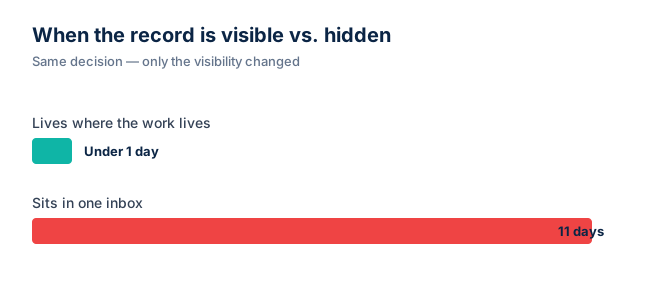
What the new clean-economy investment tax credits actually changes
Put plainly, an audit-ready project keeps these together from day one:
The decision record. Who approved what, when, and on what basis — captured as it happened, not reconstructed under pressure.
Meeting minutes and direction. Especially anything that changed scope, schedule, or budget.
Procurement justification. Why this vendor, this price, this process — documented at the time, not rationalized after.
Closeout and retention. What was delivered, who signed for it, and proof you kept what you must keep.
Version history. Proof of which drawing, spec, or policy was current on any given day.
What changes the outcome isn't heroics at audit time. It's removing the gap between doing the work and recording it.
That is exactly what one auditable system is built to do. It keeps capital projects and the records that prove them in one auditable system — approvals, versions, contracts, and change orders, each with a name and a date attached.
What changes the result for forestry operators is not another database. It's that one auditable system captures the record as a by-product of the work, ingesting from the inboxes and folders you already use — so being ready costs no extra effort.
The new clean-economy investment tax credits raised the ceiling on what's possible. Whether forestry operators reach it comes down to something unglamorous: whether the proof was there all along.
Why parallel systems quietly multiply
For forestry operators, the second system always starts with a good reason. The accounting team needed a faster way to track commitments, so they built a spreadsheet. The PMs needed a clearer view of schedule, so they built another. The board wanted a one-page summary, so someone built a third. None of these are wrong on their own. Together, they create a quiet tax: every Friday, somebody reconciles the three views and decides which one to believe.
The cost is not the spreadsheets. The cost is the decisions made on the wrong version. A vendor gets paid twice because two systems both showed an open invoice. A project gets reported as on-budget because the commitment register lagged the contract log. A board reviews a number that no longer matches the source.
What a single source of truth actually changes
Reports stop being authored and start being generated.
Reconciliation moves from weekly ritual to occasional spot-check.
New staff are productive in days instead of months.
Auditors confirm rather than reconstruct.
Leadership trusts the number on the screen.
Inventory the duplicates. Every parallel tracker is a candidate for retirement or absorption.
Pick the canonical record per data type. Contracts here, invoices there, schedule in one place.
Retire the rest, with a date. "Eventually" never arrives.
Train on the canonical view. Habits beat policy.
Measure the reconciliation hours saved. What you measure, you keep.
Why this matters is structural. Forestry operators that consolidate the record consolidate the decision-making with it. There is no longer a debate about which number is real; there is one number, with a trail behind it. XNM-VISION is designed for that consolidation. The project, the contracts, the invoices, the schedule, and the documents share one home, and every report rolls up from the same source — so leadership and the field are looking at the same picture, at the same time.
If your last review felt like a fire drill, that's a records problem, not a character flaw — and a solvable one. See how teams make ready their resting state with XNM-VISION.