Funded, Approved, and Still Stuck: Non-profits in 2023

When the 2023 Fall Economic Statement dominated the headlines in 2023, non-profits felt the pressure shift. The era of arguing for funding is giving way to a harder era of accounting for it.
The stakes are simple. When you can't show a decision, you don't just lose an argument — you lose time, money, and the benefit of the doubt, usually all at once.
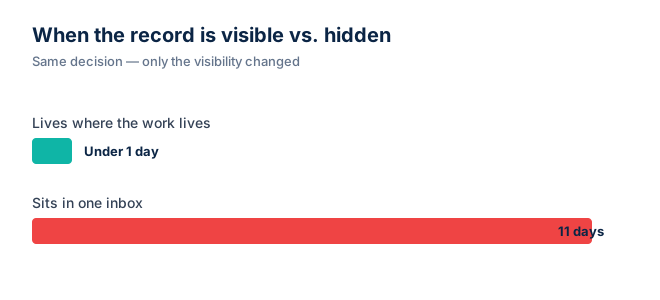
The decision wasn't wrong — it was invisible
For non-profits, the trouble starts when the record of the work and the work itself drift apart. Approvals live in inboxes, contracts live on someone's drive, and the field never sees either.
For non-profits juggling grant-funded work and reporting deadlines, the gap is structural, not personal. No amount of diligence closes a gap that is built into how the tools are wired together.
Consider how this plays out for non-profits in practice. A decision gets made in a meeting, refined over a few emails, approved with a nod, and then executed by a crew who never saw any of it written down. Months later — often once the 2023 Fall Economic Statement has put every project under a brighter light — someone asks a question that should be easy: show me where this was approved, and by whom. The work itself was sound. The trail behind it was not. And it is precisely in that gap, between a good decision and a provable one, that budgets quietly disappear and schedules slip.
In practice, the gaps cluster in a few familiar places:
The current drawing, versus three that look almost identical
The signed copy, versus the draft everyone kept editing
The retention proof that you kept what you must keep
The single thread that explains why a number changed
The decision wasn't wrong — it was invisible
Here is what belongs in one place, with a name and a date on every item:
Version history. Proof of which drawing, spec, or policy was current on any given day.
Meeting minutes and direction. Especially anything that changed scope, schedule, or budget.
Invoices matched to the contract. Each dollar paid, tied to the commitment that authorized it.
Closeout and retention. What was delivered, who signed for it, and proof you kept what you must keep.
The contract and its change orders. The original plus every amendment, in order, with nothing living only in an email thread.
None of this is a discipline problem. Diligent people lose records every day. It's a structure problem — and structure is fixable.
the XNM-VISION records engine closes that gap for non-profits. Every decision, document, and dollar lives in one place, captured as the work happens, so 'audit-ready' is your resting state rather than a sprint.
And it scales with the work, not the headcount: from a single capital project to a whole portfolio, the record stays consistent, current, and provable on demand.
Being delivery-ready early — with the record built in from day one — is the quiet advantage. It doesn't make headlines, but it's the difference between a project that finishes and one that stalls.
What this looks like on a real week
Picture a Tuesday morning where the program lead opens a single dashboard and sees, at a glance, which approvals are waiting, which drawings changed since Friday, and which invoices are about to come due. Nothing is hunted; nothing is forwarded; nothing waits for one person to come back from holiday. The act of opening the file is the act of being audit-ready.
Now picture the same Tuesday without that view. A coordinator pings three inboxes. A site lead is using last month's drawing because the latest version landed only on a desktop in head office. An invoice gets paid against a scope that quietly changed in a meeting nobody minuted. None of it is anyone's fault in particular; all of it is the consequence of letting the record live in a dozen places at once.
Approvals routed to a role, not a single inbox, so a vacation never stops the work
Drawings and specs versioned in one place, with the current revision marked and the history one click away
Invoices linked to the contract and the change order they belong to, so coding is never guesswork
Field notes and photos attached to the task they describe, not stranded on a phone
How to start without rebuilding everything
The instinct on hearing all this is to brace for a migration project, a six-month rebuild, and a fight with the IT calendar. That is the old way. The teams getting ahead are doing the opposite: they pick one live project, move its record into one place, and let the next project copy the pattern. The system grows with the work instead of waiting for the work to pause.
In practice that means: keep what already works on paper, pull the live decisions into a shared workspace, and let the older archives be loaded as time permits. The point is not perfection on day one. The point is that from day one, the next decision is captured the right way, with a name and a date, in the place everyone is already looking.
Pick one live project. A current build or program with active approvals, contracts, and invoices — not a finished one.
Map the five record types that matter. Approvals, decisions, versions, procurement, and minutes. Skip the rest until these five are real.
Move the next decision, not the last one. Start the discipline on tomorrow's approval; bring the back-catalogue in as you have time.
Show one stakeholder the difference. A funder, a board member, a partner agency — one person who used to wait, now answered in minutes.
Repeat on project two. Copy the workspace, change the names, and the pattern compounds.
What changes for the team is smaller than it sounds and bigger than it looks. The work is the same; the proof is built in. The next review is not a sprint; it is a click.
Want to see what one source of truth looks like for your projects? Talk to us — it's a short conversation.