Funded, Approved, and Still Stuck: Joint ventures in 2025
tariff uncertainty reshaping procurement made one thing clear in 2025: getting capital projects approved is no longer the bottleneck. Delivering them — and being able to show your work — is.
And the bill always comes due at the worst moment: mid-build, mid-audit, or mid-dispute, when the missing piece is suddenly the only piece that matters.
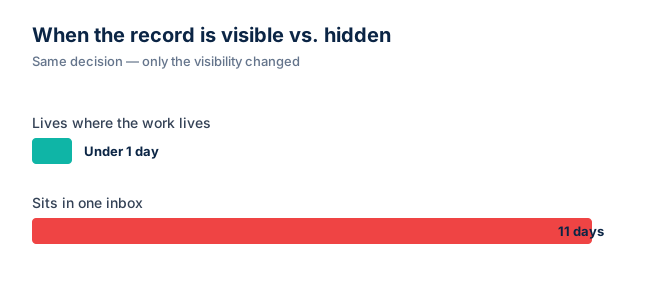
The decision wasn't wrong — it was invisible
Most joint ventures are managing shared-ownership projects with many partners across email, spreadsheets, and three or four tools that don't talk to each other. The information exists. It just can't be assembled when it counts.
Look closer at any joint ventures and the same fault line appears: the people doing the work and the people who must answer for it are reading from different copies. One has the latest drawing; the other has last month's.
Consider how this plays out for joint ventures in practice. A decision gets made in a meeting, refined over a few emails, approved with a nod, and then executed by a crew who never saw any of it written down. Months later — often once tariff uncertainty reshaping procurement has put every project under a brighter light — someone asks a question that should be easy: show me where this was approved, and by whom. The work itself was sound. The trail behind it was not. And it is precisely in that gap, between a good decision and a provable one, that budgets quietly disappear and schedules slip.
In practice, the gaps cluster in a few familiar places:
The current drawing, versus three that look almost identical
The signed copy, versus the draft everyone kept editing
The retention proof that you kept what you must keep
The single thread that explains why a number changed
The decision wasn't wrong — it was invisible
Funded does not mean moving
A project can be fully funded, fully approved, and still sit. The money is in the account. The decision memo is signed. The schedule says construction should have started. And yet, nothing moves, because a permit condition was never closed, a community consultation was promised but never logged, a procurement document is waiting on a clarification, or a partner agency has a sign-off in a queue nobody can see into.
Each of these is a small thing. Together, they form the most common reason capital projects miss their start window. And because the cause is distributed across multiple owners and systems, no single person sees the full picture in time to clear it.
The clearing list every paused project deserves
What is the next required decision, and who owns it? If the answer takes more than five minutes to produce, the project is at risk of slipping further.
What documents are blocking that decision? Most blockers are document blockers. A missing letter, an unsigned amendment, an incomplete report.
What date does the funder expect the next milestone? Funders are patient when informed and impatient when surprised. The clearing list should always show the next reporting deadline.
What is the cost of waiting one more month? Carrying costs, escalation, and risk of funding clawback. Most teams underestimate this by a large margin.
A project that can answer those four questions in writing every Monday rarely stays stuck. A project that cannot is stuck in slow motion, whether or not anyone has said so out loud.
Put plainly, an audit-ready project keeps these together from day one:
Version history. Proof of which drawing, spec, or policy was current on any given day.
The contract and its change orders. The original plus every amendment, in order, with nothing living only in an email thread.
The decision record. Who approved what, when, and on what basis — captured as it happened, not reconstructed under pressure.
Invoices matched to the contract. Each dollar paid, tied to the commitment that authorized it.
Closeout and retention. What was delivered, who signed for it, and proof you kept what you must keep.
The way out is not more effort. It's a single place where the decision, the document, and the work are the same object.
XNM-VISION turns the scattered exhaust of a project into a single auditable record. For joint ventures, that means a partner, funder, or auditor can be answered in minutes, not weeks.
And it scales with the work, not the headcount: from a single capital projects to a whole portfolio, the record stays consistent, current, and provable on demand.
The lesson repeats across every sector. You don't survive scrutiny by preparing for it. You survive by never being in a position that needs preparing.
How XNM-VISION turns this into a daily habit
The reason these problems persist on capable teams is structural, not personal. The records, approvals, and decisions that prove a project live in different systems with different owners. XNM-VISION holds them together in one tenant-scoped workspace: every project has a record, every record has its documents and links, every change is audit-logged with the user and time. The work of staying ready stops being a separate workstream and becomes a side effect of doing the work itself.
That shift — from periodic catch-up to continuous readiness — is what changes outcomes. The funder report writes itself from the records already in the system. The audit walk-through is a tour of what is already there, not a scramble to assemble it. The leadership update is a current view, not a recreation. And when a market or policy change arrives, the response time shrinks from weeks to hours, because the data needed to decide is already in one place.
XNM has helped public-sector and capital teams make audit-ready their normal state since 2013. See how XNM-VISION works.