Funded, Approved, and Still Stuck: Developers in 2024

When the push to close the First Nations infrastructure gap by 2030 dominated the headlines in 2024, developers felt the pressure shift. The era of arguing for funding is giving way to a harder era of accounting for it.
The stakes are simple. When you can't show a decision, you don't just lose an argument — you lose time, money, and the benefit of the doubt, usually all at once.
Funded is not the same as finished
For developers, the trouble starts when the record of the work and the work itself drift apart. Approvals live in inboxes, contracts live on someone's drive, and the field never sees either.
Look closer at any developers and the same fault line appears: the people doing the work and the people who must answer for it are reading from different copies. One has the latest drawing; the other has last month's.
There is a reason this keeps happening even to careful developers. The tools that hold the work — email, shared drives, spreadsheets, a project app or two — were each built to do one job well, not to keep a single, time-stamped record of what was decided and why. So the record becomes a manual chore bolted onto the real work, and it is the first thing to slip when pro formas, draws, and a wall of contracts gets busy. In a year shaped by the push to close the First Nations infrastructure gap by 2030, that one dropped chore is exactly what returns, months later, as a finding, a dispute, or a number nobody can explain.
When a project gets questioned, these are the items everyone scrambles for:
A funder's reporting requirement nobody mapped to a document
An approval that exists but isn't visible to the work
A commitment made in a meeting and never written down
The one attachment that proves the whole timeline
A closer look at where the record breaks for developers
In day-to-day work, developers rarely lose a project on a single big mistake. The damage is quieter: a budget figure that does not match the one quoted to the funder, an approval that no one can place in time, a change order whose price is correct but whose justification is missing. Each gap is small on its own. Stacked together, they turn a routine close-out into a months-long reconciliation exercise.
The pattern is almost always the same. The team that lived the project remembers it clearly. The team that has to defend it on paper sees only fragments. Bridging the two costs hours that were never budgeted, and the answer that finally emerges is often weaker than what actually happened.
A single project folder that holds the contract, the change orders, the invoices, and the approvals against them.
Time-stamped notes captured when the decision is made, not reconstructed from memory weeks later.
A clear owner for every record, so nothing sits in a shared inbox waiting for someone to claim it.
A visible link between the budget figure quoted upstream and the spend recorded downstream.
A generic scenario worth recognising
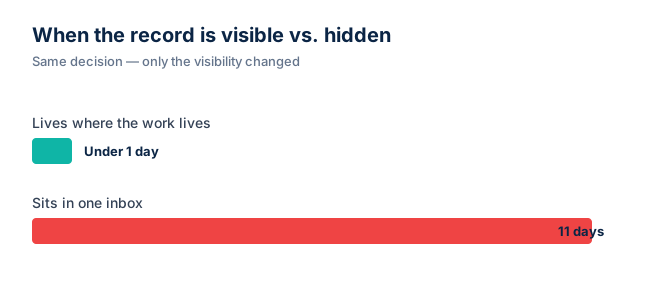
What the push to close the First Nations infrastructure gap by 2030 actually changes
Here is what belongs in one place, with a name and a date on every item:
Version history. Proof of which drawing, spec, or policy was current on any given day.
Closeout and retention. What was delivered, who signed for it, and proof you kept what you must keep.
Meeting minutes and direction. Especially anything that changed scope, schedule, or budget.
The decision record. Who approved what, when, and on what basis — captured as it happened, not reconstructed under pressure.
Invoices matched to the contract. Each dollar paid, tied to the commitment that authorized it.
You don't solve this with another reminder or another folder. You solve it by making the record a by-product of doing the work, not a second job.
That is exactly what the XNM-VISION records engine is built to do. It keeps capital projects and the records that prove them in one auditable system — approvals, versions, contracts, and change orders, each with a name and a date attached.
Crucially, the XNM-VISION records engine doesn't ask developers to change how they work. It sits on top of the sources you already have, turning scattered effort into one auditable trail without a migration project.
The push to close the First Nations infrastructure gap by 2030 raised the ceiling on what's possible. Whether developers reach it comes down to something unglamorous: whether the proof was there all along.
Picture a mid-sized capital project that ran for three years. The original scope shifted twice. Funding came from two streams with different reporting calendars. Three contractors touched the work, each with its own invoicing rhythm. None of this is unusual. What separates the teams that finish cleanly from the teams that get stuck is whether each of those moving parts left a trail that someone else can read without a phone call.
When developers get this right, an external reviewer can land on the project page and answer their own questions. When they get it wrong, every review turns into a series of interviews, and every interview turns into a fresh round of guesswork.
Practical steps to take this quarter
Name the system of record. Decide, in writing, which tool holds the authoritative version of each artefact. Everything else is a copy.
Close the inbox gap. Move approvals out of email threads into a place where a future reader can find them without forwarding chains.
Tie money to scope. Every invoice should point back to a line item, a change order, or a contract clause that justifies it.
Schedule the quiet audit. Pick a closed project at random each quarter and ask a colleague who was not on it to reconstruct the story from records alone.
Why this matters and how XNM-VISION helps
The reason this matters is not abstract. It is the difference between developers who can answer a funder, a board, or an auditor in an afternoon, and developers who need a week, three meetings, and a temporary hire to put the same story together. The work was done in both cases. Only one team can prove it cleanly.
XNM-VISION is built to make that proof routine. Projects, documents, approvals, budgets, invoices, and change orders sit in one place, linked to the people and dates that produced them. When a question lands, the answer is already on the page. The team is not pulled off forward-looking work to defend last quarter's decisions, and the record does not depend on any single person remembering what happened.
This is the gap XNM closes for capital teams. Learn how in our overview of XNM-VISION.