Funded, Approved, and Still Stuck: Developers in 2023

Ask anyone running pro formas, draws, and a wall of contracts what kept them up in 2023, and the federal Housing Accelerator Fund is only half the answer. The other half is quieter: the fear of not being able to find the one record that settles a question.
And the bill always comes due at the worst moment: mid-build, mid-audit, or mid-dispute, when the missing piece is suddenly the only piece that matters.
The decision wasn't wrong — it was invisible
developers rarely fail for lack of effort. They fail because the proof is scattered — a sign-off here, an invoice there, a change order in a thread no one can find under pressure.
And it bites hardest exactly when it matters most. The day a funder calls, the week an audit lands, the moment a dispute starts — that is when developers learn which records they can actually produce and which they only thought they had.
Consider how this plays out for developers in practice. A decision gets made in a meeting, refined over a few emails, approved with a nod, and then executed by a crew who never saw any of it written down. Months later — often once the federal Housing Accelerator Fund has put every project under a brighter light — someone asks a question that should be easy: show me where this was approved, and by whom. The work itself was sound. The trail behind it was not. And it is precisely in that gap, between a good decision and a provable one, that budgets quietly disappear and schedules slip.
Here is where the proof tends to hide:
Which version of the budget is the real one
Whether a scope change was ever formally approved
The minutes where direction actually changed
Closeout proof of what was delivered and who signed for it
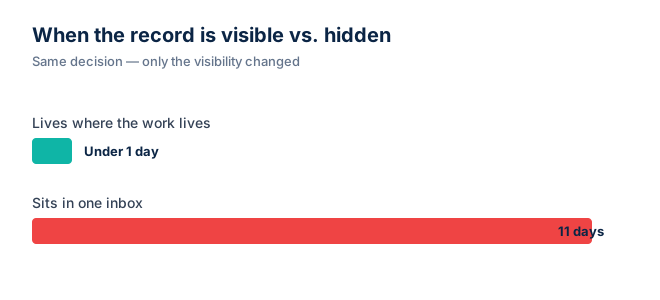
Where the proof goes to hide
Put plainly, an audit-ready project keeps these together from day one:
The decision record. Who approved what, when, and on what basis — captured as it happened, not reconstructed under pressure.
Approvals and sign-offs. Every gate with a name and date attached, visible to everyone the decision touches.
The contract and its change orders. The original plus every amendment, in order, with nothing living only in an email thread.
Closeout and retention. What was delivered, who signed for it, and proof you kept what you must keep.
Invoices matched to the contract. Each dollar paid, tied to the commitment that authorized it.
The fix isn't 'try harder.' It's to stop keeping the record separate from the work, so the proof accumulates on its own.
That is exactly what one auditable system is built to do. It keeps capital projects and the records that prove them in one auditable system — approvals, versions, contracts, and change orders, each with a name and a date attached.
What changes the result for developers is not another database. It's that one auditable system captures the record as a by-product of the work, ingesting from the inboxes and folders you already use — so being ready costs no extra effort.
the federal Housing Accelerator Fund raised the ceiling on what's possible. Whether developers reach it comes down to something unglamorous: whether the proof was there all along.
What the gap looks like in practice
Imagine a mid-sized capital project in its second year: a new community building, a road rebuild, or a housing block. The original scope has shifted twice, the prime contractor has issued three change orders, and the funder has asked for a quarterly progress note. Nothing on that list is unusual; what makes it painful is that the answers live in five inboxes, two shared drives, a stack of printed binders, and one person's memory.
When a question lands, somebody has to choose between giving a fast answer that may be wrong and a slow answer that is correct but late. Both choices erode trust. Over a long enough timeline, that erosion becomes the project's real cost — not the line item that overran, but the credibility that quietly drained away while everyone was busy.
A decision was made in a meeting but never written down in a place anyone can find later
Two versions of the same drawing are in circulation and nobody is sure which one the crew is building from
An invoice arrives that no one can match to a signed contract or change order
A funder asks for a report and the team rebuilds it from scratch instead of exporting it
How XNM-VISION closes the loop
XNM-VISION does not ask teams to work harder; it asks the system to remember more. Every approval, version, dollar, and document is stamped with a name and a date as the work happens, then linked to the project, the contract, and the decision it belongs to. The record is a by-product of the work, not a second job bolted on after the fact.
The practical effect is quiet but compounding. The weekly status meeting gets shorter because the status is already visible. The audit response gets faster because the evidence is already assembled. The funder relationship gets calmer because the next question is answered before it is asked.
Make the record the work. Capture approvals, invoices, and versions in the same place the team already operates — not in a parallel filing exercise.
Link everything to a project. A document with no project is a document that will be lost; a document tied to a project is a document that explains itself a year later.
Show the trail. Every change should carry a name, a date, and a reason, visible to anyone the work touches without a special request.
Export, don't rebuild. When a funder or auditor asks, the answer should be a download, not a project.
None of this requires a heroic change-management campaign. It requires a default that favours the next person who has to answer a question about this project — which is, more often than not, a future version of the team itself.
XNM has helped public-sector and capital teams make audit-ready their normal state since 2013. See how XNM-VISION works.