Anatomy of an Overrun: When Capital projects Outrun the Paperwork

When the new premium on delivery-readiness dominated the headlines in 2026, municipalities felt the pressure shift. The era of arguing for funding is giving way to a harder era of accounting for it.
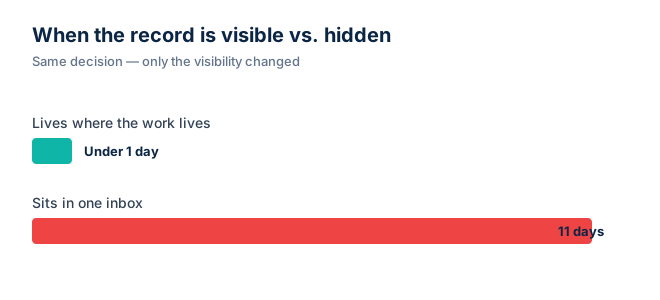
This matters because the cost of a lost record is rarely the record. It's the six weeks, the redone work, and the credibility you spend reconstructing something you already had.
Where the proof goes to hide
For municipalities, the trouble starts when the record of the work and the work itself drift apart. Approvals live in inboxes, contracts live on someone's drive, and the field never sees either.
It compounds over time. Every handoff between municipalities and their partners is a chance for a version to fork, an approval to go unrecorded, or a commitment to survive only in someone's memory.
There is a reason this keeps happening even to careful municipalities. The tools that hold the work — email, shared drives, spreadsheets, a project app or two — were each built to do one job well, not to keep a single, time-stamped record of what was decided and why. So the record becomes a manual chore bolted onto the real work, and it is the first thing to slip when roads, water, and facilities renewal gets busy. In a year shaped by the new premium on delivery-readiness, that one dropped chore is exactly what returns, months later, as a finding, a dispute, or a number nobody can explain.
Here is where the proof tends to hide:
The current drawing, versus three that look almost identical
The signed copy, versus the draft everyone kept editing
The retention proof that you kept what you must keep
The single thread that explains why a number changed
What the new premium on delivery-readiness actually changes
These are the records that turn a hard question into a two-minute answer:
Invoices matched to the contract. Each dollar paid, tied to the commitment that authorized it.
Version history. Proof of which drawing, spec, or policy was current on any given day.
Meeting minutes and direction. Especially anything that changed scope, schedule, or budget.
Closeout and retention. What was delivered, who signed for it, and proof you kept what you must keep.
Approvals and sign-offs. Every gate with a name and date attached, visible to everyone the decision touches.
The fix isn't 'try harder.' It's to stop keeping the record separate from the work, so the proof accumulates on its own.
XNM-VISION closes that gap for municipalities. Every decision, document, and dollar lives in one place, captured as the work happens, so 'audit-ready' is your resting state rather than a sprint.
What changes the result for municipalities is not another database. It's that XNM-VISION captures the record as a by-product of the work, ingesting from the inboxes and folders you already use — so being ready costs no extra effort.
Being delivery-ready early — with the record built in from day one — is the quiet advantage. It doesn't make headlines, but it's the difference between a project that finishes and one that stalls.
What 'audit-ready' actually looks like for an Overrun
It is tempting to treat audit-readiness as a quarterly scramble: gather what you can, paper over what you cannot, hope the questions land somewhere you have answers. That posture works until it doesn't. The next time an Overrun are asked to defend a decision, it will not come with two weeks' notice. It will come on a Tuesday, by phone, with a single question that needs an answer in the room.
A practical definition of readiness is simpler than it sounds. It means a third party can land on any one of your projects, pick any one decision, and trace it from the original ask to the signed approval to the dollar that left the bank — without anyone going hunting. Everything they need is already where they can find it, in the form they would expect to see it.
That is not a technology problem in disguise. It is a habit problem. The teams that get there decide, once, that the record will be created at the point of the work, not reconstructed later from memory.
A useful test you can run this week
Pick one live project. Pick three recent decisions: an approval, a change order, and an invoice. For each one, time how long it takes someone other than the person who made the decision to retrieve all four pieces: the request, the justification, the approval, and the result. If any leg of that takes more than two minutes, you have found a place where an Overrun carry hidden risk.
The request that started the decision, with the date it was raised
The justification, written at the time and not invented afterwards
The approval, with a name attached and the version it approved
The downstream result — the invoice, the deliverable, the closed item
None of this requires heroics. It requires that the four pieces live in one place, linked to each other, so that retrieving one of them surfaces the rest.
Putting it in practice
In practice, an Overrun who close this gap tend to do it in three short moves, in this order:
Name the source of truth. Pick one place where the current version of every approval, contract, and decision lives. Everywhere else becomes a working draft.
Capture the why, not just the what. Each approval carries a one-line reason in plain language. That single sentence is what saves the next conversation.
Close the loop. Every invoice and deliverable links back to the approval that authorized it. If it cannot, it does not get paid or accepted.
Done once and held to, this is what turns 'we think we approved that' into 'here is the approval, the version it approved, and the result it produced.' For an Overrun, that shift is the whole game.
None of the steps above are exotic. What is rare is the discipline to keep doing them on the day the schedule slips and the easy thing is to send another email and figure it out later. The teams that hold the line earn back hours every week and remove the slow tax that 'figure it out later' charges on every project.
This is exactly where XNM-VISION earns its keep for an Overrun. It is built so the record is a by-product of the work, not a separate chore. The approval, the version it approved, and the invoice it authorized are linked the moment they exist — so when the question comes, the answer is already there.
We take apart a failure like this every week. Closing exactly this gap is why we built XNM-VISION.