Anatomy of an Overrun: When Capital projects Outrun the Paperwork
When tighter scrutiny of provincial capital plans dominated the headlines in 2024, developers felt the pressure shift. The era of arguing for funding is giving way to a harder era of accounting for it.
What's really at risk isn't tidiness. It's whether a funder, an auditor, or a partner can look at your project and trust that it was run the way you say it was.
Funded is not the same as finished
Most developers are managing pro formas, draws, and a wall of contracts across email, spreadsheets, and three or four tools that don't talk to each other. The information exists. It just can't be assembled when it counts.
The cost isn't only the missing document. It's the meeting to look for it, the second meeting to recreate it, and the slow erosion of trust every time someone has to say 'let me get back to you on that.'
Picture the opposite, just for a moment. A capital project where every approval, version, and dollar lands in one place as it happens, each stamped with a name and a date, visible to everyone the work touches. When a funder calls or an auditor schedules a review, nothing has to be reconstructed — the answer is already there, assembled by the act of doing the work. For developers, that is not a fantasy or a bigger budget; it is a different default. And in an era defined by tighter scrutiny of provincial capital plans, that default is quietly becoming the line between the teams that deliver and the teams that stall.
When a project gets questioned, these are the items everyone scrambles for:
Which version of the budget is the real one
Whether a scope change was ever formally approved
The minutes where direction actually changed
Closeout proof of what was delivered and who signed for it
What this looks like in practice
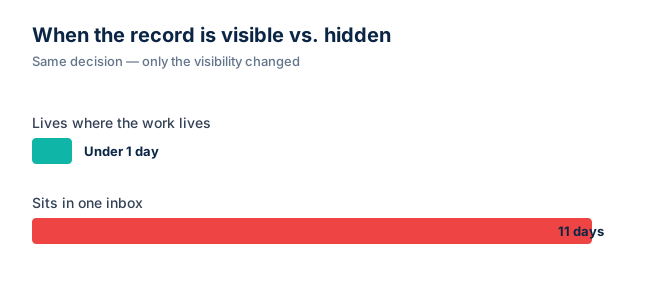
Imagine a Wednesday morning during a busy build. A funder calls about a draw, a board chair forwards an old email, and a contractor flags a change-order question all in the same hour. None of these are unusual events. They are the normal noise of teams running a real capital project. The difference between a calm response and a frantic one is rarely talent or effort. It is whether the answer can be assembled in minutes from a system that already knows where everything lives.
In that calm version, the project lead opens a single record, sees the latest version of the contract on top, the change order beneath it, and the approval email attached to both. The board chair's question is answered with a link, not a search. The funder draw is supported by an invoice that is already mapped to the milestone they care about. Nobody had to recreate anything. The work that happened months ago still speaks for itself.
In the frantic version, the same facts exist somewhere — but they are scattered across an inbox, a shared drive, two spreadsheets, and the head of one staff member who is on leave. Each question becomes a small investigation. By the end of the week, the team has spent more hours looking for records than producing them.
The decision wasn't wrong — it was invisible
Put plainly, an audit-ready project keeps these together from day one:
Closeout and retention. What was delivered, who signed for it, and proof you kept what you must keep.
The contract and its change orders. The original plus every amendment, in order, with nothing living only in an email thread.
Invoices matched to the contract. Each dollar paid, tied to the commitment that authorized it.
Procurement justification. Why this vendor, this price, this process — documented at the time, not rationalized after.
Version history. Proof of which drawing, spec, or policy was current on any given day.
You don't solve this with another reminder or another folder. You solve it by making the record a by-product of doing the work, not a second job.
That is exactly what XNM-VISION is built to do. It keeps capital projects and the records that prove them in one auditable system — approvals, versions, contracts, and change orders, each with a name and a date attached.
Teams stand it up fast: XNM-VISION deploys in days, not the months a traditional system takes, and it carries unlimited users, so every partner, reviewer, and field lead works from the same picture.
The money will keep flowing toward big builds. The teams that win the next decade won't be the ones who got funded — they'll be the ones who could prove, on any given Tuesday, exactly how the work was run.
A short, practical sequence
If you do nothing else this quarter, work through this short sequence. It will not solve every problem, but it will close the loop on the records most likely to be asked about in the next twelve months.
Pick one live project. Resist the urge to start with the whole portfolio. One real project is enough to find the gaps.
List the last five decisions. For each, locate the approval, the document it relates to, and the person who signed off. Note anything missing.
Move those five into one place. Even a single shared folder with consistent naming is a step forward, as long as the link is the same for everyone.
Write down the rules you actually follow. Not the policy on the shelf — the working practice. Then close the gap between them.
Test it with a friendly question. Ask a colleague to pull the approval and the contract for a recent change order. If it takes longer than two minutes, you have your next fix.
The reason this matters now is straightforward: the bar for showing your work has moved. Funders, councils, boards, and auditors are not asking for more documentation in absolute terms. They are asking for the same documentation, available faster, with less ambiguity about which version is current. Teams that meet that bar look organized. Teams that do not look risky, even when the underlying work is sound.
XNM-VISION sits behind the day-to-day work for teams and quietly keeps the trail intact. Every approval is timestamped. Every version is preserved. Every change order is linked to the contract it modifies. When the question comes — and it will come — the assembled answer is already there. The system did the boring part so the team could focus on the building.
XNM has helped public-sector and capital teams make audit-ready their normal state since 2013. See how XNM-VISION works.