Anatomy of an Overrun: When Capital projects Outrun the Paperwork

the national debate over permitting timelines made one thing clear in 2024: getting capital projects approved is no longer the bottleneck. Delivering them — and being able to show your work — is.
The stakes are simple. When you can't show a decision, you don't just lose an argument — you lose time, money, and the benefit of the doubt, usually all at once.
Make ready your resting state
The pattern is familiar to consulting firms: each system holds a piece of the truth, no system holds all of it, and the gaps between them are exactly where projects quietly bleed.
And it bites hardest exactly when it matters most. The day a funder calls, the week an audit lands, the moment a dispute starts — that is when consulting firms learn which records they can actually produce and which they only thought they had.
Consider how this plays out for consulting firms in practice. A decision gets made in a meeting, refined over a few emails, approved with a nod, and then executed by a crew who never saw any of it written down. Months later — often once the national debate over permitting timelines has put every project under a brighter light — someone asks a question that should be easy: show me where this was approved, and by whom. The work itself was sound. The trail behind it was not. And it is precisely in that gap, between a good decision and a provable one, that budgets quietly disappear and schedules slip.
When a project gets questioned, these are the items everyone scrambles for:
Which version of the budget is the real one
Whether a scope change was ever formally approved
The minutes where direction actually changed
Closeout proof of what was delivered and who signed for it
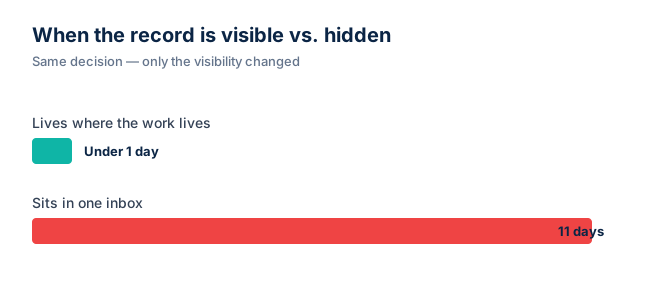
What the national debate over permitting timelines actually changes
If you keep nothing else in a single system, keep these:
Version history. Proof of which drawing, spec, or policy was current on any given day.
Invoices matched to the contract. Each dollar paid, tied to the commitment that authorized it.
Meeting minutes and direction. Especially anything that changed scope, schedule, or budget.
The contract and its change orders. The original plus every amendment, in order, with nothing living only in an email thread.
Closeout and retention. What was delivered, who signed for it, and proof you kept what you must keep.
The fix isn't 'try harder.' It's to stop keeping the record separate from the work, so the proof accumulates on its own.
XNM-VISION closes that gap for consulting firms. Every decision, document, and dollar lives in one place, captured as the work happens, so 'audit-ready' is your resting state rather than a sprint.
What changes the result for consulting firms is not another database. It's that XNM-VISION captures the record as a by-product of the work, ingesting from the inboxes and folders you already use — so being ready costs no extra effort.
the national debate over permitting timelines raised the ceiling on what's possible. Whether consulting firms reach it comes down to something unglamorous: whether the proof was there all along.
What this looks like on a real week
Picture a Tuesday afternoon at a capital project team. A funder calls and asks for the latest signed change order, the matching invoice, and the board minutes that approved the contingency draw. The person on the phone says yes, of course, and then the search begins. Someone checks a shared drive, someone else opens an email thread from eight months ago, and a third person walks down the hall to ask the controller. Forty minutes later, three slightly different PDFs have surfaced and nobody is sure which one is the version that was actually executed.
None of those people did anything wrong. They are working with the tools they have. The problem is that the tools were not designed to answer the question the funder just asked. They were designed to store files, send messages, and track tasks. Proving a number, on demand, with the paper to back it, is a different job.
The hidden cost of that Tuesday afternoon is not the forty minutes. It is the small loss of trust each time the answer takes that long, and the slow drift toward defensive habits, where capital project teams start over-documenting in private spreadsheets just so they personally can find things later. That drift is what eventually shows up as a finding in an audit or a delay in a draw.
The three records most teams still cannot pull cleanly
The signed, executed version of a change order linked to the invoice that drew against it and the approval that authorised it.
A clean, dated trail of who made each scope decision, with the meeting note or memo that captured the reasoning at the time.
A current, single-source register of commitments, encumbrances and remaining budget, reconciled to the general ledger as of this morning.
These are not exotic asks. They are the basic evidence a funder, auditor or board chair will request at least once per project. The teams that handle them calmly are not the ones with more staff. They are the ones who decided, at some point, that the system of record had to be one place, and that everything else was just a working copy.
A practical sequence that works
Pick one project as the pilot. Not the biggest, not the smallest. Pick the one with the most active funders and the most change orders, because that is where the pain is loudest and the wins are most visible.
Inventory the evidence you already have. Before you migrate anything, list the documents that prove the last five financial decisions. If you cannot find them in ten minutes, that is the first problem to solve.
Link, do not move. The goal is not to relocate every file. The goal is to make sure that from one record - the contract, the change order, the invoice - you can reach everything attached to it in one click.
Run a dry funder request. Pick a question a funder has actually asked in the last year and time how long it takes to answer it now. Then time it again after the pilot. The delta is your business case.
In our experience, a capital project team that runs this sequence gets the first measurable result in roughly two weeks. The result is rarely a dramatic transformation. It is a quiet shift: the next funder request is answered in twelve minutes instead of two days, and nobody had to stay late.
Why this matters for the next two years
Capital project oversight is getting tighter, not looser. Funders are asking sharper questions. Boards want quarterly evidence, not annual reassurance. Indigenous equity partners want to see their interests reflected in the books in something close to real time. The teams that treat their records as a strategic asset will move faster, borrow cheaper, and partner more confidently. The teams that treat records as filing will keep doing the Tuesday afternoon search, and will keep paying for it in slower decisions and smaller margins.
This is not about buying software for its own sake. It is about deciding that the next time a funder, auditor or partner asks the question, the answer will be on the screen before they finish the sentence. Everything else flows from that decision.
This is the gap XNM closes for capital teams. Learn how in our overview of XNM-VISION.