Anatomy of an Overrun: When Capital projects Outrun the Paperwork

When Budget 2024's Indigenous Loan Guarantee Program dominated the headlines in 2024, Nation governments felt the pressure shift. The era of arguing for funding is giving way to a harder era of accounting for it.
The quiet truth is that most overruns aren't decisions gone wrong. They're decisions that went fine but couldn't be proven, defended, or found in time.
Funded is not the same as finished
The real problem for Nation governments isn't missing information — it's unfindable information. The approval, the version, the justification all exist; they just don't live where the work can see them.
The cost isn't only the missing document. It's the meeting to look for it, the second meeting to recreate it, and the slow erosion of trust every time someone has to say 'let me get back to you on that.'
Step back and the pattern is almost mechanical. Money arrives, ambition rises, the project grows — and the volume of decisions grows with it, faster than any inbox or folder can keep straight. For Nation governments, the failure is rarely dramatic; it is a slow accumulation of small, unrecorded moments that only add up to a problem when someone with authority starts asking questions. Budget 2024's Indigenous Loan Guarantee Program is making that someone show up sooner, and more often. The teams that feel calm about it are not working harder — they simply never let the record and the work drift apart in the first place.
In practice, the gaps cluster in a few familiar places:
The current drawing, versus three that look almost identical
The signed copy, versus the draft everyone kept editing
The retention proof that you kept what you must keep
The single thread that explains why a number changed
A day in the life of the missing record
Picture a typical Tuesday. A funder calls about a line item from a quarterly report. The team lead remembers the discussion — it happened on a site walk in late February — but cannot find the email that confirmed the decision. Someone checks the shared drive. Someone else pulls a phone log. Forty minutes later, the answer arrives, half-defended, half-apologetic. The cost of that single answer, multiplied across a year and a portfolio, is the real budget overrun.
For capital projects teams, the meeting that mattered usually happened. The decision was usually right. What goes missing is the connective tissue: the email that confirmed it, the version of the drawing it was based on, the change order that referenced it. None of these are dramatic losses on their own. Together, they are the reason an honest project looks suspicious in hindsight.
Three quiet failure modes
The decision exists, but the proof is on a former staff member's laptop.
The approval exists, but it is buried in a thread no search can find.
The version exists, but no one can say which version was current on the relevant day.
None of these are rare. All of them are preventable — once the record is captured as work happens, rather than reconstructed once a question lands.
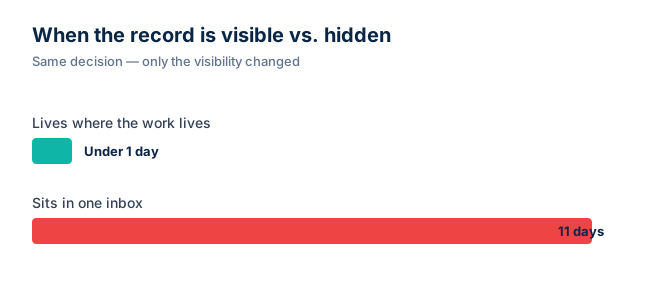
What Budget 2024's Indigenous Loan Guarantee Program actually changes
The short list of what should never be left scattered:
Invoices matched to the contract. Each dollar paid, tied to the commitment that authorized it.
The decision record. Who approved what, when, and on what basis — captured as it happened, not reconstructed under pressure.
Meeting minutes and direction. Especially anything that changed scope, schedule, or budget.
Procurement justification. Why this vendor, this price, this process — documented at the time, not rationalized after.
Closeout and retention. What was delivered, who signed for it, and proof you kept what you must keep.
The fix isn't 'try harder.' It's to stop keeping the record separate from the work, so the proof accumulates on its own.
One auditable system closes that gap for Nation governments. Every decision, document, and dollar lives in one place, captured as the work happens, so 'audit-ready' is your resting state rather than a sprint.
Crucially, one auditable system doesn't ask Nation governments to change how they work. It sits on top of the sources you already have, turning scattered effort into one auditable trail without a migration project.
Being delivery-ready early — with the record built in from day one — is the quiet advantage. It doesn't make headlines, but it's the difference between a project that finishes and one that stalls.
What changes when the record is built in
When capital projects teams stop chasing paperwork after the fact, three things shift at once. First, the lead time on funder questions collapses from days to minutes. Second, the team stops re-litigating decisions that were already made — because the basis is right there, attached to the decision. Third, staff turnover stops costing institutional memory, because the memory lives in the system, not in any one person's inbox.
Make capture the easy path. If saving the record costs an extra click, it will not happen on the busy days when it matters most.
Link the proof to the decision. A decision without its supporting documents is just an assertion. Pair them at the moment of approval.
Freeze versions at milestones. At every gate — funding, design, tender, closeout — lock the package that the decision was based on so it can be re-read later.
Treat the audit trail as a product. Design it to be readable by someone who was not in the room, because that is exactly who will eventually read it.
In practice, this looks unglamorous. There is no single dashboard moment. Instead, the daily rhythm of the work quietly produces a defensible record as a by-product. The team does not feel like they are doing more administration; if anything, they feel like they are doing less, because the second pass — the reconstruction — has disappeared.
Why this matters now: the federal scrutiny cycle has tightened, the eligible-cost rules have hardened, and the window between a question and a published finding has shrunk. Capital projects teams that wait for an audit to start building the record are already late. Capital projects teams that have the record assembled before the question is asked are quietly free to spend their time on the next project, not the last one.
How XNM-VISION helps: it puts the contract, the change orders, the meeting record, the version history, the decision log, and the procurement rationale on one screen, indexed and linked. When a reviewer asks, the answer is one search. When a teammate joins, the onboarding is reading the record, not interviewing whoever has been there longest.
If your last review felt like a fire drill, that's a records problem, not a character flaw — and a solvable one. See how teams make ready their resting state with XNM-VISION.