Anatomy of an Overrun: When Capital projects Outrun the Paperwork

Through 2023, developers watched the widening municipal infrastructure deficit move money and attention toward big builds. The capital is the easy part. The hard part shows up later, in whether you can prove what you decided and when.
What's really at risk isn't tidiness. It's whether a funder, an auditor, or a partner can look at your project and trust that it was run the way you say it was.
The decision wasn't wrong — it was invisible
For developers, the trouble starts when the record of the work and the work itself drift apart. Approvals live in inboxes, contracts live on someone's drive, and the field never sees either.
For developers juggling pro formas, draws, and a wall of contracts, the gap is structural, not personal. No amount of diligence closes a gap that is built into how the tools are wired together.
There is a reason this keeps happening even to careful developers. The tools that hold the work — email, shared drives, spreadsheets, a project app or two — were each built to do one job well, not to keep a single, time-stamped record of what was decided and why. So the record becomes a manual chore bolted onto the real work, and it is the first thing to slip when pro formas, draws, and a wall of contracts gets busy. In a year shaped by the widening municipal infrastructure deficit, that one dropped chore is exactly what returns, months later, as a finding, a dispute, or a number nobody can explain.
Here is where the proof tends to hide:
The decision record — who approved what, when, and on what basis
Invoices matched to the contract that authorized them
The procurement justification, documented at the time
Version history proving which drawing was current on a given day
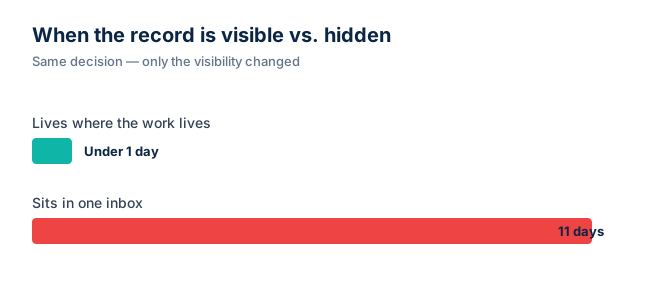
Where the proof goes to hide
Put plainly, an audit-ready project keeps these together from day one:
Closeout and retention. What was delivered, who signed for it, and proof you kept what you must keep.
The contract and its change orders. The original plus every amendment, in order, with nothing living only in an email thread.
Version history. Proof of which drawing, spec, or policy was current on any given day.
Procurement justification. Why this vendor, this price, this process — documented at the time, not rationalized after.
Invoices matched to the contract. Each dollar paid, tied to the commitment that authorized it.
The fix isn't 'try harder.' It's to stop keeping the record separate from the work, so the proof accumulates on its own.
This is the problem the XNM-VISION records engine was designed around: one source of truth for pro formas, draws, and a wall of contracts, ingesting from the inboxes and folders you already use, so nothing has to be reassembled later.
Crucially, the XNM-VISION records engine doesn't ask developers to change how they work. It sits on top of the sources you already have, turning scattered effort into one auditable trail without a migration project.
Funding gets you to the starting line. Records are what carry you across it. In a year defined by the widening municipal infrastructure deficit, that distinction is the whole game.
What 'audit-ready' actually looks like in practice
Audit-ready is not a binder. It is a posture. It means that on any normal Tuesday, with no warning, the team can pull a clean line from a funding commitment to a contract, to the invoices paid against it, to the change orders that moved the price, to the approvals that authorised each move. No scramble. No favours from the one person who happens to remember. Just the record, where the work lives.
In real life that posture is built quietly. Each approval is captured at the moment it happens. Each invoice is tied to the contract that authorised it before it gets paid, not after the auditor asks. Each change order names the decision behind it and the people who signed it. None of these steps are heavy. They are the same steps the team is already doing — just captured once, in the place the rest of the work lives.
The payoff shows up at the worst possible moments, which is the point. A reporter calls. A regulator asks. A funder wants a status note by the end of the day. A new project lead joins the team and needs to understand what happened last year. In each of those moments, audit-ready means the answer is already there. The team is not rebuilding the past — they are reading it.
Where teams quietly lose ground
Most teams do not lose ground in one big mistake. They lose it slowly, in small detours that each look harmless. A decision made in a meeting and confirmed in a chat. A contract amended over email and never re-filed. An invoice paid against a verbal okay that nobody wrote down. Each detour is a reasonable answer to a real time pressure. Added up over a year, they are exactly the gaps that show up on audit week.
The teams that hold the line do one boring thing well: they capture the small artefacts as they happen. The two-line email confirming an approval. The marked-up scope. The note that explains why this invoice was paid even though the line item was slightly different. None of these are documents in the heavy sense. They are just proof, written down where everyone can find it later.
Pick one project as the pilot. Not the easiest, not the hardest — a representative one where the team is already paying attention. Use it to set the standard the rest of the portfolio will follow.
Map the spine first. Funding source → contract → invoices → change orders → approvals. If any link in that chain is unclear today, fix the chain before adding more detail anywhere else.
Capture approvals at the moment they happen. Not at month-end, not at audit time. The approval and the record of it should be the same act, in the same place.
Tie every invoice to a contract before paying it. This single habit eliminates most of the painful reconciliations later and surfaces scope drift while it is still cheap to fix.
Review the spine monthly with the team. Ten minutes. What is unlinked? What is missing? What looks wrong? Small fixes done monthly beat heroic fixes done annually.
Why this matters now
Capital projects in 2026 do not fail quietly anymore. Funders publish status. Communities watch dashboards. Boards expect proof, not narrative. When something goes sideways — and on a long project, something always goes sideways — the difference between a manageable issue and a public one is whether the record can explain what happened, in order, without anyone having to remember.
The teams that move first on this do not get rewarded with applause. They get rewarded with quiet. Fewer fire drills. Faster funder responses. Cleaner handovers when a project lead moves on. A boring outcome — but boring is exactly what a capital project is supposed to look like from the outside.
How XNM-VISION helps: it keeps the spine — funding, contracts, invoices, change orders, approvals — in one auditable system, so the proof is built as a by-product of the work the team is already doing. Nothing extra to remember. Nothing to assemble at the last minute. Just the record, where it lives.
XNM has helped public-sector and capital teams make audit-ready their normal state since 2013. See how XNM-VISION works.