After the widening municipal infrastructure deficit: The Question Municipalities Should Be Asking

Through 2023, municipalities watched the widening municipal infrastructure deficit move money and attention toward big builds. The capital is the easy part. The hard part shows up later, in whether you can prove what you decided and when.
What's really at risk isn't tidiness. It's whether a funder, an auditor, or a partner can look at your project and trust that it was run the way you say it was.
Where the proof goes to hide
municipalities rarely fail for lack of effort. They fail because the proof is scattered — a sign-off here, an invoice there, a change order in a thread no one can find under pressure.
And it bites hardest exactly when it matters most. The day a funder calls, the week an audit lands, the moment a dispute starts — that is when municipalities learn which records they can actually produce and which they only thought they had.
Picture the opposite, just for a moment. A capital projects where every approval, version, and dollar lands in one place as it happens, each stamped with a name and a date, visible to everyone the work touches. When a funder calls or an auditor schedules a review, nothing has to be reconstructed — the answer is already there, assembled by the act of doing the work. For municipalities, that is not a fantasy or a bigger budget; it is a different default. And in an era defined by the widening municipal infrastructure deficit, that default is quietly becoming the line between the teams that deliver and the teams that stall.
The usual suspects, every time:
The decision record — who approved what, when, and on what basis
Invoices matched to the contract that authorized them
The procurement justification, documented at the time
Version history proving which drawing was current on a given day
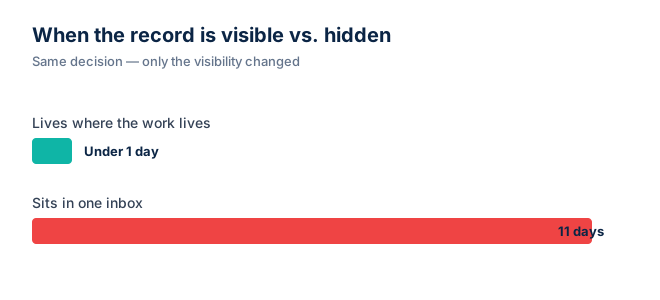
The decision wasn't wrong — it was invisible
If you keep nothing else in a single system, keep these:
Meeting minutes and direction. Especially anything that changed scope, schedule, or budget.
The decision record. Who approved what, when, and on what basis — captured as it happened, not reconstructed under pressure.
Invoices matched to the contract. Each dollar paid, tied to the commitment that authorized it.
Version history. Proof of which drawing, spec, or policy was current on any given day.
Procurement justification. Why this vendor, this price, this process — documented at the time, not rationalized after.
The fix isn't 'try harder.' It's to stop keeping the record separate from the work, so the proof accumulates on its own.
one auditable system turns the scattered exhaust of a project into a single auditable record. For municipalities, that means a partner, funder, or auditor can be answered in minutes, not weeks.
And it scales with the work, not the headcount: from a single capital projects to a whole portfolio, the record stays consistent, current, and provable on demand.
Funding gets you to the starting line. Records are what carry you across it. In a year defined by the widening municipal infrastructure deficit, that distinction is the whole game.
What this looks like on the ground
Talk to any seasoned project lead and the story is consistent: the work itself is rarely the problem. The problem is the trail of small artefacts — a marked-up drawing, a one-line email, a verbal yes in a hallway — that quietly become the official record. None of those artefacts are wrong on their own. They simply do not survive contact with a serious question six months later.
Picture a mid-sized capital file with two prime consultants, a handful of subcontractors, a community liaison, and a finance lead who joined three months in. Each of them is doing competent work. Each of them is also keeping a private version of the truth in their own inbox or shared drive. When a regulator, board, or funder asks a precise question, the team has to reconcile those private versions in real time. The answer takes days, not minutes, and confidence drops with every hour.
The pattern is so common that it begins to look like a personal failing. It is not. It is a structural gap between how decisions actually get made and how the official record is captured. Until that gap is closed at the tool layer, every project will quietly pay a tax in time, rework, and avoidable explanations.
Early signals that the system is drifting
Most teams know the system is drifting before any audit confirms it. The early signals are small but consistent, and they tend to cluster in the same places:
Two people answer the same question differently in the same week.
The latest version of a key document lives somewhere nobody can name.
A change order shows up on an invoice before anyone remembers approving it.
Onboarding a new team member takes a full day of folder spelunking.
The finance lead and the project lead are reconciling spreadsheets by hand.
Three practical steps to take this quarter
None of this needs to be solved by heroics. A handful of grounded moves, repeated quarter after quarter, will close most of the gap:
Pick one source of truth per record type. Contracts, drawings, minutes, approvals, invoices — each gets one home, and the home is named in writing.
Capture the why next to the what. Every change to scope, schedule, or budget gets a one-line rationale attached to the artefact, not buried in an email thread.
Make the version visible. Anyone looking at a document should see, without asking, whether it is the current one and who signed it last.
Reconcile invoices to commitments weekly. Not at year-end. A short weekly pass closes nine out of ten surprises before they become disputes.
The reason this matters is not abstract. Teams that work this way recover hours every week, defend decisions without rehearsing them, and walk into reviews already prepared. The teams that do not work this way are not lazier or less skilled; they are simply paying a structural tax that compounds with every quarter.
XNM-VISION is built around exactly this discipline. The contract, the change orders, the approvals, the version history, the invoices, and the conversations that produced them all live together, linked to the project and the dollar they belong to. The audit-ready state is not a sprint at the end of the year — it is the resting state of the system.
If your last review felt like a fire drill, that's a records problem, not a character flaw — and a solvable one. See how teams make ready their resting state with XNM-VISION.