After the national debate over permitting timelines: The Question Non-profits Should Be Asking

Through 2024, non-profits watched the national debate over permitting timelines move money and attention toward big builds. The capital is the easy part. The hard part shows up later, in whether you can prove what you decided and when.
This matters because the cost of a lost record is rarely the record. It's the six weeks, the redone work, and the credibility you spend reconstructing something you already had.
Where the proof goes to hide
non-profits rarely fail for lack of effort. They fail because the proof is scattered — a sign-off here, an invoice there, a change order in a thread no one can find under pressure.
For non-profits juggling grant-funded work and reporting deadlines, the gap is structural, not personal. No amount of diligence closes a gap that is built into how the tools are wired together.
Consider how this plays out for non-profits in practice. A decision gets made in a meeting, refined over a few emails, approved with a nod, and then executed by a crew who never saw any of it written down. Months later — often once the national debate over permitting timelines has put every project under a brighter light — someone asks a question that should be easy: show me where this was approved, and by whom. The work itself was sound. The trail behind it was not. And it is precisely in that gap, between a good decision and a provable one, that budgets quietly disappear and schedules slip.
The usual suspects, every time:
Which version of the budget is the real one
Whether a scope change was ever formally approved
The minutes where direction actually changed
Closeout proof of what was delivered and who signed for it
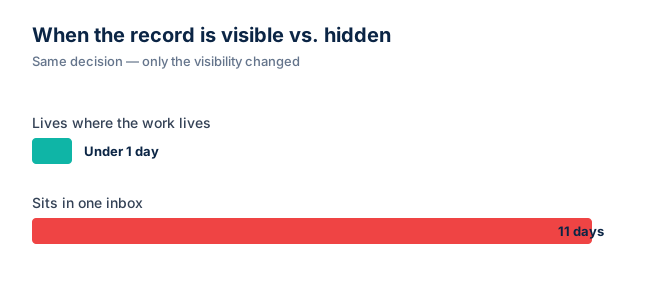
The decision wasn't wrong — it was invisible
Put plainly, an audit-ready project keeps these together from day one:
Invoices matched to the contract. Each dollar paid, tied to the commitment that authorized it.
Version history. Proof of which drawing, spec, or policy was current on any given day.
Approvals and sign-offs. Every gate with a name and date attached, visible to everyone the decision touches.
Procurement justification. Why this vendor, this price, this process — documented at the time, not rationalized after.
Closeout and retention. What was delivered, who signed for it, and proof you kept what you must keep.
None of this is a discipline problem. Diligent people lose records every day. It's a structure problem — and structure is fixable.
XNM-VISION turns the scattered exhaust of a project into a single auditable record. For non-profits, that means a partner, funder, or auditor can be answered in minutes, not weeks.
The payoff for non-profits is calm. When a question comes, the answer is already assembled — approval, version, and justification side by side — so a review becomes a search, not a scramble.
The lesson repeats across every sector. You don't survive scrutiny by preparing for it. You survive by never being in a position that needs preparing.
What this looks like on a real project
Picture a mid-size build that runs for two or three years. The funding agreement is amended twice. The design changes after the second consultation round. A subcontractor swaps mid-stream. By month eighteen, the project file on the shared drive is a graveyard of near-duplicates: 'final', 'final-v2', 'final-FOR-SIGNATURE', 'final-USE-THIS-ONE'. None of them carry the authority trail. None of them prove which version was current the day a decision was made. This is the moment where audits get expensive and questions get answered with 'we think so.'
The fix is unglamorous: keep the record next to the work, not on a parallel drive. Every approval is attached to the document it approves. Every revision is dated, signed, and superseded by the next one, not deleted. Every funder requirement is mapped to the specific clause, drawing, or receipt that satisfies it. When the question comes a year later, the answer is one click, not one week.
The recurring failure modes
Decisions made in meetings that never make it back into the document set
Email approvals that live only in one person's inbox and disappear when they leave
Spreadsheet trackers that drift out of sync with the actual signed documents
Storage by person or by phase instead of by project, so context dies at handover
Reporting templates rebuilt from scratch each cycle because nobody trusts the source data
A practical sequence for legal and project leads
You do not need to boil the ocean to fix this. The teams that get on top of it tend to follow the same short sequence. It works because each step makes the next one cheaper.
Pick one project that is mid-flight. Not the easiest one and not the worst one. The one where the cost of getting this wrong is highest in the next six months.
Map the funder and statutory requirements first. Write down, in plain language, what evidence each one will ultimately demand. This is your acceptance criteria, not a wish list.
Move the record into one place. One project, one home, one version history. Resist the urge to keep 'just one' parallel folder.
Wire approvals to the document. Sign-off lives on the file, not in a separate email thread. If it cannot be attached, it did not happen.
Set the dashboard once. What is overdue, what is unsigned, what is missing evidence. Look at it weekly, not quarterly.
None of these steps require a heroic change-management program. They require the discipline to stop treating the record as something that gets cleaned up later, when 'later' is the moment the audit, the FOI request, or the dispute lands on the desk.
Why this matters now
The volume of public money flowing into capital projects is not going to slow down. Neither is the scrutiny on how it gets spent. The teams that win the next decade are the ones that treat their record as a live operational asset, not a filing chore. Done well, the record becomes the project manager's early warning system: a contract approaching its cap, a permit nearing expiry, a deliverable a week late, all visible before they become a problem.
How XNM-VISION helps is straightforward. Every document, decision, approval, and change is captured against the project it belongs to, with the version history and the authority trail attached. The dashboard shows what is overdue, what is unsigned, and what is missing evidence, across the whole portfolio. When the question comes, the answer is already assembled. That is the difference between a record that defends you and a record that exposes you.
Want to see what one source of truth looks like for your projects? Talk to us — it's a short conversation.