After the national debate over permitting timelines: The Question Audit teams Should Be Asking
Ask anyone running working papers and the trail behind every number what kept them up in 2024, and the national debate over permitting timelines is only half the answer. The other half is quieter: the fear of not being able to find the one record that settles a question.
What's really at risk isn't tidiness. It's whether a funder, an auditor, or a partner can look at your project and trust that it was run the way you say it was.
Funded is not the same as finished
For audit teams, the trouble starts when the record of the work and the work itself drift apart. Approvals live in inboxes, contracts live on someone's drive, and the field never sees either.
It compounds over time. Every handoff between audit teams and their partners is a chance for a version to fork, an approval to go unrecorded, or a commitment to survive only in someone's memory.
Consider how this plays out for audit teams in practice. A decision gets made in a meeting, refined over a few emails, approved with a nod, and then executed by a crew who never saw any of it written down. Months later — often once the national debate over permitting timelines has put every project under a brighter light — someone asks a question that should be easy: show me where this was approved, and by whom. The work itself was sound. The trail behind it was not. And it is precisely in that gap, between a good decision and a provable one, that budgets quietly disappear and schedules slip.
Here is where the proof tends to hide:
The decision record — who approved what, when, and on what basis
Invoices matched to the contract that authorized them
The procurement justification, documented at the time
Version history proving which drawing was current on a given day
What this looks like in practice
Imagine a mid-sized capital file two years in. The funding announcement landed cleanly. The design got approved. Three contractors are mobilized. Then a reviewer asks one ordinary question — which version of the scope did the change order in March attach to? — and the room goes quiet. Nobody is hiding anything. The answer simply doesn't live in one place anyone can reach.
That moment is the entire problem in a single frame. The team has the documents. The team has the email chain. The team can almost certainly reconstruct the answer in a day or two. But the cost of "a day or two" is what nobody budgets, and it is what compounds across a portfolio: each small reconstruction adds to a quiet tax that nobody sees until renewal, audit, or handover.
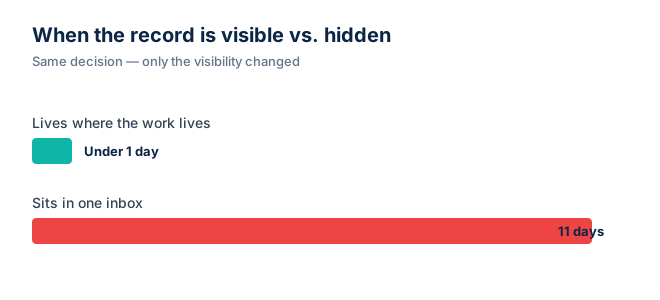
What changes when the record is structured is not heroics — it is silence. The question gets answered in the same minute it's asked, and the meeting moves on. That is the whole point.
Why this matters more than it sounds
Most teams underestimate the second-order cost of a missing record. The visible cost is the time spent searching. The hidden cost is the decision that gets made anyway, without the missing context, because waiting was not an option. Multiplied across a quarter, those decisions are how strategy quietly drifts off course.
The decision happens — it just happens with less context than the team would prefer.
The reviewer doesn't argue — they just trust your numbers a little less next time.
The funder doesn't pull the file — they just slow the next disbursement by a week.
The successor doesn't complain — they just rebuild what should have been inherited.
It is also a credibility cost. A partner who has to ask twice rarely tells you they noticed. They simply weight your next commitment a little more cautiously. Over a multi-year relationship, that compounding skepticism is more expensive than any single audit finding.
A practical sequence that works
Pick one decision class first. Don't try to fix everything. Start with the single decision type that costs you the most when it goes missing — usually change orders or approvals — and make that one airtight.
Move the proof to where the work lives. If the evidence sits in an inbox, it isn't really evidence. Pull it into the same surface the team already opens every morning.
Write the rule for the next person. Whatever you decide today, write it as if a successor will inherit it cold in eighteen months — because someone will.
Run a five-minute drill. Once a month, pick a recent decision at random and time how long it takes to produce the full record. If it's over five minutes, the structure isn't done yet.
The pitfalls we keep seeing
The most common failure mode is not technological — it is the assumption that the team will "be more careful next time." Careful people lose records every week. The fix is not more discipline; it is a structure that makes the careful path the default path.
The second most common failure is over-scoping. Teams try to standardize every decision class in one quarter, hit fatigue, and quietly revert. A narrow, finished, boring habit beats a broad, ambitious, half-finished one every time.
How XNM-VISION helps
XNM-VISION is built around one assumption: the proof should live in the same place the work lives, and it should be findable by anyone with the right permission in seconds, not days. That is not a feature — it is the posture of the whole product.
In practice that means contracts, approvals, change orders, and the meeting that triggered them all share one timeline. The version that was current on any given day is recoverable without anyone having to remember which folder it was filed in. And because the system is multi-user from the first day, the partner, the reviewer, and the field lead are looking at the same picture instead of negotiating over which copy is real.
What the national debate over permitting timelines actually changes
The short list of what should never be left scattered:
Procurement justification. Why this vendor, this price, this process — documented at the time, not rationalized after.
Version history. Proof of which drawing, spec, or policy was current on any given day.
The decision record. Who approved what, when, and on what basis — captured as it happened, not reconstructed under pressure.
Meeting minutes and direction. Especially anything that changed scope, schedule, or budget.
Approvals and sign-offs. Every gate with a name and date attached, visible to everyone the decision touches.
The way out is not more effort. It's a single place where the decision, the document, and the work are the same object.
That is exactly what XNM-VISION is built to do. It keeps capital projects and the records that prove them in one auditable system — approvals, versions, contracts, and change orders, each with a name and a date attached.
What changes the result for audit teams is not another database. It's that XNM-VISION captures the record as a by-product of the work, ingesting from the inboxes and folders you already use — so being ready costs no extra effort.
Funding gets you to the starting line. Records are what carry you across it. In a year defined by the national debate over permitting timelines, that distinction is the whole game.
If your last review felt like a fire drill, that's a records problem, not a character flaw — and a solvable one. See how teams make ready their resting state with XNM-VISION.