After the federal list of “nation-building” projects: The Question Utilities Should Be Asking

When the federal list of “nation-building” projects dominated the headlines in 2025, utilities felt the pressure shift. The era of arguing for funding is giving way to a harder era of accounting for it.
What's really at risk isn't tidiness. It's whether a funder, an auditor, or a partner can look at your project and trust that it was run the way you say it was.
Where the proof goes to hide
Most utilities are managing regulated assets and long approval chains across email, spreadsheets, and three or four tools that don't talk to each other. The information exists. It just can't be assembled when it counts.
Look closer at any utilities and the same fault line appears: the people doing the work and the people who must answer for it are reading from different copies. One has the latest drawing; the other has last month's.
Consider how this plays out for utilities in practice. A decision gets made in a meeting, refined over a few emails, approved with a nod, and then executed by a crew who never saw any of it written down. Months later — often once the federal list of “nation-building” projects has put every project under a brighter light — someone asks a question that should be easy: show me where this was approved, and by whom. The work itself was sound. The trail behind it was not. And it is precisely in that gap, between a good decision and a provable one, that budgets quietly disappear and schedules slip.
These are the records that go missing first:
A funder's reporting requirement nobody mapped to a document
An approval that exists but isn't visible to the work
A commitment made in a meeting and never written down
The one attachment that proves the whole timeline
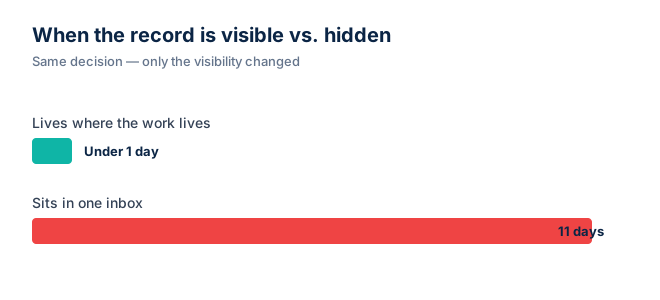
Make ready your resting state
Put plainly, an audit-ready project keeps these together from day one:
Approvals and sign-offs. Every gate with a name and date attached, visible to everyone the decision touches.
Meeting minutes and direction. Especially anything that changed scope, schedule, or budget.
The contract and its change orders. The original plus every amendment, in order, with nothing living only in an email thread.
Invoices matched to the contract. Each dollar paid, tied to the commitment that authorized it.
The decision record. Who approved what, when, and on what basis — captured as it happened, not reconstructed under pressure.
You don't solve this with another reminder or another folder. You solve it by making the record a by-product of doing the work, not a second job.
This is the problem one auditable system was designed around: one source of truth for regulated assets and long approval chains, ingesting from the inboxes and folders you already use, so nothing has to be reassembled later.
What changes the result for utilities is not another database. It's that one auditable system captures the record as a by-product of the work, ingesting from the inboxes and folders you already use — so being ready costs no extra effort.
Funding gets you to the starting line. Records are what carry you across it. In a year defined by the federal list of “nation-building” projects, that distinction is the whole game.
What good looks like in practice
A capable team does not chase paper at the end of a phase. They keep one file per decision, one trail per dollar, and one place where the field, the office, and the funder all see the same picture. The day-to-day looks slower at first; the month-end looks faster, then much faster, because nothing has to be rebuilt from memory or recovered from someone who left.
In practice, it shows up as small habits. The change order is stamped before the work proceeds, not after. The site photo is filed against the line item it proves. The minutes name a decision and the person who carries it. None of this is exotic; it is just the same work, done where it can be found again.
Name the record while the work is hot — write the note, sign the form, and attach the file before the next meeting, not at year-end.
Tie each cost to a deliverable — every invoice should map to a line item, a contract, and an approval, so the auditor's questions answer themselves.
Make the trail visible to the next person — assume the original author will be unavailable when the question lands, and write the record so a colleague can answer cold.
Why this matters more in 2026
Funders, regulators, and partner organizations are no longer satisfied with a binder produced at the end. They expect to be able to ask a question on a Tuesday afternoon and get a defensible answer the same day. Teams that cannot meet that bar lose the benefit of the doubt — and in close calls on renewals, on extensions, and on the next phase of work, the benefit of the doubt is often what the decision turns on.
The teams that win the next round are not the ones with the most documents. They are the ones whose documents are addressable, current, and trusted by everyone who has to act on them. That standard is reachable for any organization willing to put the record where the work happens.
A short check you can run this week
Pick one active project. Ask three people on it — a field lead, a finance lead, and a manager — to produce the latest approved budget, the latest approved drawing, and the last three change orders. If the three answers match within an hour and without a phone call, the system is working. If they do not, you have found the gap you should close first, before the next deadline writes the check for it.
Want to see what one source of truth looks like for your projects? Talk to us — it's a short conversation.