After the federal housing-supply push: The Question Audit teams Should Be Asking

Ask anyone running working papers and the trail behind every number what kept them up in 2024, and the federal housing-supply push is only half the answer. The other half is quieter: the fear of not being able to find the one record that settles a question.
And the bill always comes due at the worst moment: mid-build, mid-audit, or mid-dispute, when the missing piece is suddenly the only piece that matters.
What the federal housing-supply push actually changes
For audit teams, the trouble starts when the record of the work and the work itself drift apart. Approvals live in inboxes, contracts live on someone's drive, and the field never sees either.
And it bites hardest exactly when it matters most. The day a funder calls, the week an audit lands, the moment a dispute starts — that is when audit teams learn which records they can actually produce and which they only thought they had.
It helps to name the real adversary, because it is not incompetence. For audit teams, the adversary is entropy — the natural tendency of a busy project to scatter its own evidence across people, tools, and time until no single place holds the whole truth. Every reorganization, every staff change, every 'we'll clean it up later' feeds it. the federal housing-supply push did not create this problem, but it raised the cost of it, because more scrutiny means more moments when scattered evidence has to be pulled back together at speed. Structure is the only thing that reliably beats entropy.
These are the records that go missing first:
The current drawing, versus three that look almost identical
The signed copy, versus the draft everyone kept editing
The retention proof that you kept what you must keep
The single thread that explains why a number changed
What this looks like in practice
Consider a regional team mid-build on a complex package: drawings revised twice in a fortnight, a procurement carve-out negotiated by phone, a funder asking why a line item moved. None of these are unusual. What is unusual is being able to answer in minutes rather than days, because every one of those moves left a stamped trace exactly where the next person needed it.
The teams that pull this off don't run faster. They run with less friction. The record is a by-product of the work, not a separate chore that gets done on Fridays — or, more often, the Friday before something blows up.
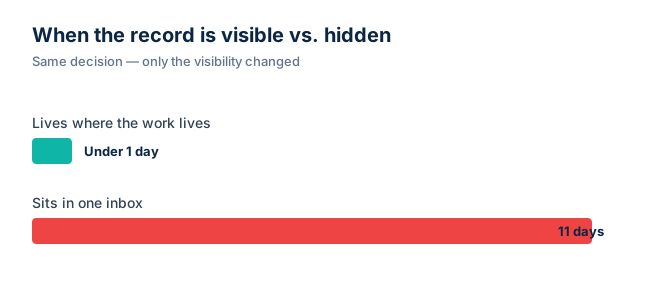
Funded is not the same as finished
The short list of what should never be left scattered:
Closeout and retention. What was delivered, who signed for it, and proof you kept what you must keep.
Meeting minutes and direction. Especially anything that changed scope, schedule, or budget.
Approvals and sign-offs. Every gate with a name and date attached, visible to everyone the decision touches.
The contract and its change orders. The original plus every amendment, in order, with nothing living only in an email thread.
Invoices matched to the contract. Each dollar paid, tied to the commitment that authorized it.
The way out is not more effort. It's a single place where the decision, the document, and the work are the same object.
The XNM-VISION records engine turns the scattered exhaust of a project into a single auditable record. For audit teams, that means a partner, funder, or auditor can be answered in minutes, not weeks.
The payoff for audit teams is calm. When a question comes, the answer is already assembled — approval, version, and justification side by side — so a review becomes a search, not a scramble.
The money will keep flowing toward big builds. The teams that win the next decade won't be the ones who got funded — they'll be the ones who could prove, on any given Tuesday, exactly how the work was run.
A short list of practical steps
Pick one project as the pilot. Not the easiest and not the hardest. The one where the next surprise will hurt the most.
Name one owner per record type. Approvals, change orders, invoices, drawings — one person responsible, with a backup who can see what they see.
Move the clock into view. Replace 'I'm waiting on so-and-so' with a status everyone the work touches can read.
Close the loop on every verbal go-ahead. If it isn't written down with a name and a date, it didn't happen.
Audit yourself once a quarter. Pick five random decisions from the last 90 days and time how long it takes to produce the full justification.
Why this matters more in 2026 than it did in 2019
Funding programs, oversight bodies, and partner organizations now expect the trail of evidence to come with the project, not after it. The bar isn't simply higher — the assumption has flipped. A clean audit used to be a credit. Now a messy one is a liability that follows the team into the next bid.
And the work itself is more entangled. A capital project today touches procurement, finance, indigenous engagement, environmental review, and a half-dozen sub-contractors before a single shovel moves. Each of those touchpoints generates a record that someone, eventually, will want to see.
Where XNM-VISION fits in
XNM-VISION doesn't replace the people, the policies, or the professional judgement that run capital work. It removes the part that quietly steals time from all three: the chase for the document, the version, the name on the approval. With those in one auditable place, judgement gets to be about the work again, not about the paperwork around it.
And because the record builds itself as the work happens, the cost curve flattens. The first project is the hardest. The tenth feels routine. The hundredth, across a whole portfolio, is the difference between a team that scales and a team that breaks.
We take apart a failure like this every week. Closing exactly this gap is why we built XNM-VISION.