After LNG Canada's first cargo: The Question Legal teams Should Be Asking

Ask anyone running matters, executed documents, and evidence trails what kept them up in 2025, and LNG Canada's first cargo is only half the answer. The other half is quieter: the fear of not being able to find the one record that settles a question.
What's really at risk isn't tidiness. It's whether a funder, an auditor, or a partner can look at your project and trust that it was run the way you say it was.
Make ready your resting state
The pattern is familiar to legal teams: each system holds a piece of the truth, no system holds all of it, and the gaps between them are exactly where projects quietly bleed.
And it bites hardest exactly when it matters most. The day a funder calls, the week an audit lands, the moment a dispute starts — that is when legal teams learn which records they can actually produce and which they only thought they had.
Step back and the pattern is almost mechanical. Money arrives, ambition rises, the project grows — and the volume of decisions grows with it, faster than any inbox or folder can keep straight. For legal teams, the failure is rarely dramatic; it is a slow accumulation of small, unrecorded moments that only add up to a problem when someone with authority starts asking questions. LNG Canada's first cargo is making that someone show up sooner, and more often. The teams that feel calm about it are not working harder — they simply never let the record and the work drift apart in the first place.
Here is where the proof tends to hide:
An approval sitting in one person's inbox, with no backup and no clock anyone else can see
A contract on a personal drive that the field crew never opens
A change order buried in an email thread
A verbal 'go ahead' that left no trace
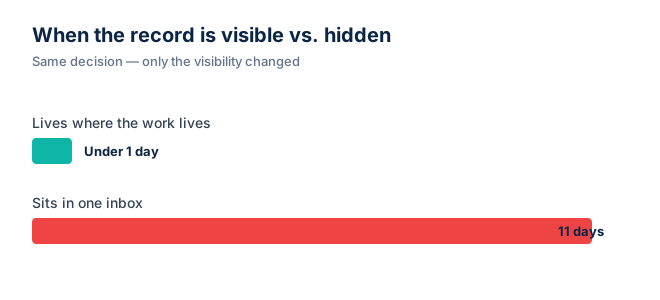
What LNG Canada's first cargo actually changes
Here is what belongs in one place, with a name and a date on every item:
The contract and its change orders. The original plus every amendment, in order, with nothing living only in an email thread.
Procurement justification. Why this vendor, this price, this process — documented at the time, not rationalized after.
Approvals and sign-offs. Every gate with a name and date attached, visible to everyone the decision touches.
Version history. Proof of which drawing, spec, or policy was current on any given day.
Meeting minutes and direction. Especially anything that changed scope, schedule, or budget.
The way out is not more effort. It's a single place where the decision, the document, and the work are the same object.
With XNM-VISION, legal teams stop hunting. The approval, the current version, and the justification sit together with a full trail — visible to everyone the decision touches, on a clock anyone can see.
And it scales with the work, not the headcount: from a single capital projects to a whole portfolio, the record stays consistent, current, and provable on demand.
Being delivery-ready early — with the record built in from day one — is the quiet advantage. It doesn't make headlines, but it's the difference between a project that finishes and one that stalls.
Where the friction usually starts
In most capital teams, the trouble does not begin with a dramatic failure. It starts with small mismatches: a budget number that someone updated in a side spreadsheet, a scope clarification agreed verbally in a hallway, a signed amendment that lives only in one person's email. None of these feel urgent in isolation. Together, they quietly become the gap that an auditor, a funder, or a board member will eventually find.
The fix is not more meetings or longer reports. It is a single place where the current version of every decision lives, with the name and date attached, the moment it happens. When that becomes the default working surface — not a system people copy into later — the friction drops because nothing has to be reconstructed.
Consider a generic but realistic scenario: a regional infrastructure team awards a contract, then issues two change orders during construction. Months later, a funder asks for the audited cost-to-date and the basis for each change. If the record was kept at the moment of the decision, the answer is a search. If it was not, it is three weeks of interviews and forensic email reading.
A single working version of every key document, with prior versions kept but clearly archived
An attached name and date on every approval, sign-off, and scope change
A short written reason next to every procurement award, captured at the time
A simple way for the people doing the work to log what changed, without leaving their tools
What good looks like in practice
In practice, an audit-ready workspace does not require heroic discipline from every team member. It requires that the path of least resistance is also the right path. When the easiest place to drop a signed PDF is also the official record, when the easiest way to log a decision is also the auditable log, behavior follows the design.
Practical steps that move teams in that direction, in roughly the order they tend to land:
Pick one home for the record. Decide where the official version of each artifact lives, and retire the side copies.
Attach names and dates by default. Every approval, every sign-off, every change carries a person and a moment, captured as it happens.
Keep the reason next to the decision. A two-sentence note at the time beats a paragraph of reconstruction later.
Make the audit view a click away. If pulling the full trail takes a single search, the team will keep using the system that produces it.
The deeper benefit is cultural. When the record is reliable, conversations change. Disagreements move faster because the facts are not in dispute. New team members get up to speed in days instead of weeks, because the history of the project is legible without a guide. And leadership can ask harder questions, because the answers are available.
Why this matters now: funders, regulators, and boards are tightening their expectations around traceability and timeliness. The teams that build the record as the work happens will spend their energy on the work. The teams that do not will spend their energy on reconstruction — and on explaining the gaps.
How XNM-VISION helps is straightforward. It keeps the current version, the approval, the reason, and the trail in one auditable place, accessible to the right people at the right tier, with the audit view ready whenever it is asked for. The system does the remembering so the team can keep building.
This is the gap XNM closes for capital teams. Learn how in our overview of XNM-VISION.