A Field Guide to Audit-Ready Capital projects for Project teams

When the drive to modernize public-sector records dominated the headlines in 2026, project teams felt the pressure shift. The era of arguing for funding is giving way to a harder era of accounting for it.
What "audit-ready" actually looks like on a Tuesday
Audit-ready is not a binder you build at year-end. For project teams, it is the ordinary state of the file on a random Tuesday in mid-project — the version on screen matches the version on site, the approval is attached to the change it authorised, and the person who needs to answer a question can find the answer without phoning three colleagues.
That sounds modest, but it is exactly the bar that fails most often. A site engineer pulls a drawing from a shared drive folder named with last week's date. A controller cuts a payment against a PO whose scope was quietly widened in an email thread nobody copied. A board member asks why a number moved and the only honest answer is "we'll get back to you." None of these are integrity failures. They are structure failures, and they compound.
The fix is not more discipline. It is a single place where the decision, the version that was current when it was made, and the people who saw it all live together — and stay together as the work moves forward.
The quiet truth is that most overruns aren't decisions gone wrong. They're decisions that went fine but couldn't be proven, defended, or found in time.
The records that settle questions
For project teams, the trouble starts when the record of the work and the work itself drift apart. Approvals live in inboxes, contracts live on someone's drive, and the field never sees either.
And it bites hardest exactly when it matters most. The day a funder calls, the week an audit lands, the moment a dispute starts — that is when project teams learn which records they can actually produce and which they only thought they had.
Step back and the pattern is almost mechanical. Money arrives, ambition rises, the project grows — and the volume of decisions grows with it, faster than any inbox or folder can keep straight. For project teams, the failure is rarely dramatic; it is a slow accumulation of small, unrecorded moments that only add up to a problem when someone with authority starts asking questions. The drive to modernize public-sector records is making that someone show up sooner, and more often. The teams that feel calm about it are not working harder — they simply never let the record and the work drift apart in the first place.
When a project gets questioned, these are the items everyone scrambles for:
The decision record — who approved what, when, and on what basis
Invoices matched to the contract that authorized them
The procurement justification, documented at the time
Version history proving which drawing was current on a given day
A scenario that should feel familiar
Picture a mid-sized capital build where project teams are sixteen months in. The original budget was set on a feasibility study from two summers ago. Since then, three change orders have moved the scope, a key supplier renegotiated lead times after a tariff change, and the lender quietly asked for an updated risk register before the next draw. Each of those events was handled — but each lived in a different tool.
When the funder asks for a clean reconciliation of "how we got from the approved budget to today's forecast," the team spends nine days assembling something defensible. The work was done correctly. The proof of the work was scattered. The cost of the scatter is the nine days plus the credibility tax that follows: the funder now reads every future ask through a slightly more skeptical lens.
The version of this story that ends well looks identical from the outside — same change orders, same supplier shift, same lender request. The only difference is that the answer takes two hours instead of nine days, and it is the same answer no matter who in the team pulls it.
What that team did differently
Every change order was logged against the original line item it amended, with a one-line rationale captured at the moment of approval, not after.
Supplier correspondence was attached to the contract record it affected, so the renegotiated lead time lived next to the clause it changed.
The risk register was a living view of the project record, not a separate spreadsheet that someone updated quarterly when they remembered.
Every figure shown in the funder report could be clicked through to the underlying document and the date it became authoritative.
A practical week-one checklist
If you are a project team reading this and wondering where to start, the move is not to buy a new tool tomorrow. It is to inventory what you already have and decide what your authoritative record is for each class of decision.
Name the system of record for each artefact. One place for contracts, one place for drawings, one place for approvals — and nowhere else. Ambiguity is the enemy.
Make the current version obvious at a glance. Not buried in a filename convention only the original author understands.
Capture the why at the moment of the what. A two-sentence rationale on a change order is worth a thousand reconstructions six months later.
Give the audit trail a single front door. If your answer to "can you show me" requires opening four apps, the trail is not ready.
Rehearse the worst likely question. Pick a number on your current report and walk it back to source. If you cannot do that in under ten minutes, the gap is structural.
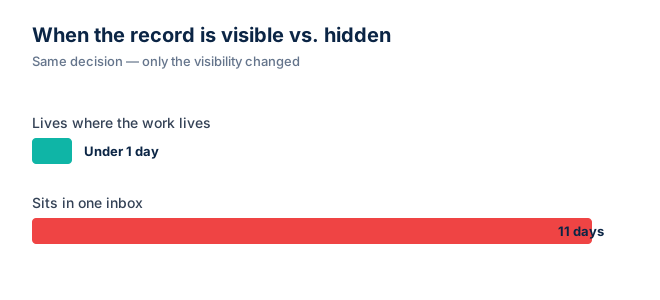
What the drive to modernize public-sector records actually changes
These are the records that turn a hard question into a two-minute answer:
Approvals and sign-offs. Every gate with a name and date attached, visible to everyone the decision touches.
Procurement justification. Why this vendor, this price, this process — documented at the time, not rationalized after.
Meeting minutes and direction. Especially anything that changed scope, schedule, or budget.
The contract and its change orders. The original plus every amendment, in order, with nothing living only in an email thread.
Closeout and retention. What was delivered, who signed for it, and proof you kept what you must keep.
The fix isn't 'try harder.' It's to stop keeping the record separate from the work, so the proof accumulates on its own.
The XNM-VISION records engine turns the scattered exhaust of a project into a single auditable record. For project teams, that means a partner, funder, or auditor can be answered in minutes, not weeks.
Crucially, the XNM-VISION records engine doesn't ask project teams to change how they work. It sits on top of the sources you already have, turning scattered effort into one auditable trail without a migration project.
Being delivery-ready early — with the record built in from day one — is the quiet advantage. It doesn't make headlines, but it's the difference between a project that finishes and one that stalls.
Why this matters more in 2026 than it did in 2024
The funding environment has shifted. Lenders, grant programs, and public-sector oversight bodies are no longer satisfied with quarterly narratives — they expect to see the underlying record on request, sometimes inside the same week. That is a real change in the operating tempo, and it is not going to relax.
For project teams, the practical consequence is that the cost of a disorganised record has moved from "annoying at audit" to "actively expensive in the next draw." The teams that recognise this early will spend less time defending the work and more time doing it. The teams that wait will be defending the work either way — they will just be doing it under worse conditions.
XNM-VISION exists for exactly this gap. It is not a replacement for the tools that already work for you. It is the layer underneath that makes sure the record is one record, current, attributable, and provable on demand — so the next funder question, the next board question, and the next regulator question all get the same answer, from the same source, in the time it takes to open a tab.
If your last review felt like a fire drill, that's a records problem, not a character flaw — and a solvable one. See how teams make ready their resting state with XNM-VISION.