A Field Guide to Audit-Ready Capital projects for Non-profits

Ask anyone running grant-funded work and reporting deadlines what kept them up in 2024, and the new clean-economy investment tax credits are only half the answer. The other half is quieter: the fear of not being able to find the one record that settles a question.
This matters because the cost of a lost record is rarely the record. It's the six weeks, the redone work, and the credibility you spend reconstructing something you already had.
Where the proof goes to hide
The real problem for non-profits isn't missing information — it's unfindable information. The approval, the version, the justification all exist; they just don't live where the work can see them.
And it bites hardest exactly when it matters most. The day a funder calls, the week an audit lands, the moment a dispute starts — that is when non-profits learn which records they can actually produce and which they only thought they had.
There is a reason this keeps happening even to careful non-profits. The tools that hold the work — email, shared drives, spreadsheets, a project app or two — were each built to do one job well, not to keep a single, time-stamped record of what was decided and why. So the record becomes a manual chore bolted onto the real work, and it is the first thing to slip when grant-funded work and reporting deadlines gets busy. In a year shaped by the new clean-economy investment tax credits, that one dropped chore is exactly what returns, months later, as a finding, a dispute, or a number nobody can explain.
In practice, the gaps cluster in a few familiar places:
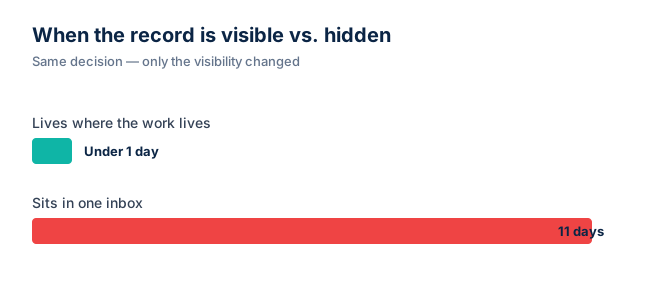
An approval sitting in one person's inbox, with no backup and no clock anyone else can see
A contract on a personal drive that the field crew never opens
A change order buried in an email thread
A verbal 'go ahead' that left no trace
What the new clean-economy investment tax credits actually changes
The short list of what should never be left scattered:
Procurement justification. Why this vendor, this price, this process — documented at the time, not rationalized after.
Closeout and retention. What was delivered, who signed for it, and proof you kept what you must keep.
Invoices matched to the contract. Each dollar paid, tied to the commitment that authorized it.
Approvals and sign-offs. Every gate with a name and date attached, visible to everyone the decision touches.
Meeting minutes and direction. Especially anything that changed scope, schedule, or budget.
You don't solve this with another reminder or another folder. You solve it by making the record a by-product of doing the work, not a second job.
With XNM-VISION, non-profits stop hunting. The approval, the current version, and the justification sit together with a full trail — visible to everyone the decision touches, on a clock anyone can see.
Crucially, XNM-VISION doesn't ask non-profits to change how they work. It sits on top of the sources you already have, turning scattered effort into one auditable trail without a migration project.
The new clean-economy investment tax credits raised the ceiling on what's possible. Whether non-profits reach it comes down to something unglamorous: whether the proof was there all along.
What gets lost between systems
The damage is rarely a single dramatic failure. It is the steady accumulation of small gaps: the spec attached to one email but not the project folder, the change order discussed on a call but never written up, the contract amendment signed but never linked to the invoices it controls. None of these feels urgent in the moment. Together, by year three of a multi-year build, they form a fog that no spreadsheet can burn off.
The teams who escape this pattern have one thing in common. They stopped treating the record as something to be assembled later, and started treating it as the natural by-product of getting the work done. The difference shows up the first time a funder asks a hard question and the answer arrives in minutes, not days.
A single intake address that turns every inbound email into a filed record automatically
Versioned drawings and specs so the current set is never in doubt
Approvals captured as structured events with a name, a timestamp and a basis
Invoices linked to the contract clause that authorized the spend
A closeout package that builds itself as gates are passed, not at the end
A small scene from a typical week
Picture a regional team mid-build. A reviewer flags a concern about a substitution that was made eight months earlier. In the old world, that question triggers a week of archaeology: who signed off, against which drawing, on what basis. In the new world, the answer is one click: the approval, the superseded spec, the email thread, the affected invoices, all on one page, in order, with names and dates.
That is not a productivity gain. It is a different posture in front of every funder, auditor and board. It is the difference between being on defence and being able to lead the conversation.
Pick one project to stand up first. Not the biggest or the messiest, but the one whose record you are most likely to be asked about in the next six months.
Point the intake address at the people already doing the work. Forward in, file once, no second job.
Set the gates that matter. Approvals, change orders, invoice match. Skip ceremony, keep proof.
Rehearse the audit answer. Pick five likely questions and time how long it takes to answer them today. Measure again in 30 days.
Why this matters now
Capital dollars are moving faster than they ever have, and the cost of slow proof is climbing with them. Programs are being layered: federal, provincial, own-source, partner contributions, each with its own reporting rhythm. The team that can answer cleanly across all of them earns the next round. The team that cannot is told, politely, to come back when things are tidier.
XNM-VISION is built for this moment. It does not ask anyone to change how they work day-to-day. It quietly captures the record as work happens, and gives every authorized person the same picture, in the same place, at the same time.
Want to see what one source of truth looks like for your projects? Talk to us — it's a short conversation.